Dapper is cool. It provides an interface and service by which you can build your own screenscraper (they don't call it that) for any arbitrary site and then output the scraped content into various formats (e.g. HTML, custom XML, RSS, iCal, etc).
So it's an end-run around sites that don't themselves provide APIs. You use Dapper to scrape their pages and effectively create your own API. The key difference is that you define what gets scraped rather than somebody else.
As an example, I created a 'Dapp' from this blog, using the Dapper interface to specify that I wanted only the post titles and following metadata (e.g. posted by, # of comments etc) scraped. I chose to have XML as the output format and the result is here. No programming necessary (although some would be required in order to use the 'feed').
Inherent to screen-scraping, it's fragile - as soon as I change the blog template, the Dapp could break. I also wonder how long the window of opportunity will remain open - if Blogger had an API and gave me (or others) control over what data was relevant then the need for Dapper disappears.
Wednesday, October 04, 2006

Tuesday, October 03, 2006
Well duh
Kaliya blogged the TechCrunch article on IMSafer.
From that article, the following caught my eye:
From that article, the following caught my eye:
While multiple screen names can be tracked at home, the company is working on a tool to associate different screen names across school and home to notify parents.If only there were technology to help.
Updated SAML Basics Slides

Eve has uploaded a new version of her excellent deck to the OASIS SSTC public page.
It's available in both OpenOffice document format and PDF (the source format is supposed to have some animations but I couldn't see them).
For me, it's the graphics that steal the show (isn't there some saying about graphics and their worth etc?), especially the callouts on the various XML structures.
Cardspace on Zune?
Why not? Zune's primary distinguishing feature seems to the wireless connectivity designed to enable (DRM-constrained) song sharing. I wonder what control the user will have over such sharing, a binary on/off determined by enabling WiFi? Or something more granular?
Cardspace would allow a Zuner (can I trademark this?) to specify which identity aspects get advertised in which contexts. I might show a different set of songs in an after hours (I hear they can be open till midnight!) club than I would in an airport terminal. Other Zuners could define ACLs for their playlists and songs in terms of the required identity characteristics of potential recipients (e.g. if you advertise that you like 'Broadway Show Tunes' then you should just keep searching).
I'd be interested to hear Microsoft's story on how they see Cardspace working in a social world.
Cardspace would allow a Zuner (can I trademark this?) to specify which identity aspects get advertised in which contexts. I might show a different set of songs in an after hours (I hear they can be open till midnight!) club than I would in an airport terminal. Other Zuners could define ACLs for their playlists and songs in terms of the required identity characteristics of potential recipients (e.g. if you advertise that you like 'Broadway Show Tunes' then you should just keep searching).
I'd be interested to hear Microsoft's story on how they see Cardspace working in a social world.
Mothers-in-law & technology
Before she lost her son last month, if you had said 'web address' to my mother-in-law, she would have assumed you were talking about the street location of a spider's spinning endeavours. No longer unfortunately.
A photo site dedicated to her son, and her desire to inform far flung friends and family of it's existence and location, has forced her to deal (albeit from a distance) with the technology she so successfully avoided up till now.
Of course she doesn't have email, so the communication channel by which she broadcasts the above address is good old Canada Post. Consequently, there have been many a phone call along the lines of:
Mom: Can I get that address for Jamie's photos again?
Me: Sure, it's 'w w w'
Mom: capitals?
Me: doesn't matter , but no, no capitals.
Mom: OK, 'www'
Me: 'dot flickr dot com'
Mom: Got it
Me: Now a line starting from bottom left and ending top right
Mom: K
Me: 'photos' and another line like above
Mom: K
Me: 'jamiemurraylife' and that's it
Mom: Got it. Any dot at the end?
Me: Nope. Now it doesn't change so you could write it down and save it for next time
Mom: Oh, I'd probably just lose it. I'll just call you back.
Me: Righto. Talk to you tomorrow.
Using the POTS to communicate a web address for snail mail forwarding. Now that's convergence.
A photo site dedicated to her son, and her desire to inform far flung friends and family of it's existence and location, has forced her to deal (albeit from a distance) with the technology she so successfully avoided up till now.
Of course she doesn't have email, so the communication channel by which she broadcasts the above address is good old Canada Post. Consequently, there have been many a phone call along the lines of:
Mom: Can I get that address for Jamie's photos again?
Me: Sure, it's 'w w w'
Mom: capitals?
Me: doesn't matter , but no, no capitals.
Mom: OK, 'www'
Me: 'dot flickr dot com'
Mom: Got it
Me: Now a line starting from bottom left and ending top right
Mom: K
Me: 'photos' and another line like above
Mom: K
Me: 'jamiemurraylife' and that's it
Mom: Got it. Any dot at the end?
Me: Nope. Now it doesn't change so you could write it down and save it for next time
Mom: Oh, I'd probably just lose it. I'll just call you back.
Me: Righto. Talk to you tomorrow.
Using the POTS to communicate a web address for snail mail forwarding. Now that's convergence.
Monday, October 02, 2006
I agree 100% but ......
Ping Identity's Patrick clarifies his thinking on what user-centric identity management is, and how various identity systems (e.g. Cardspace, SAML, OpenID etc) can support it.
Patrick reintroduces his 'passive' and 'active' distinction, expressing the varying abilities of clients for enforcing the user's wishes for identity sharing (and probably other identity functions like IDP discovery too).
One issue. Patrick writes
Lots of use-cases have the users online so that their client can actively mediate their identity flow, lots of others don't.
Patrick reintroduces his 'passive' and 'active' distinction, expressing the varying abilities of clients for enforcing the user's wishes for identity sharing (and probably other identity functions like IDP discovery too).
One issue. Patrick writes
The caveat here is that active federation implies that the user is an active participant in the flow of identity (if not necessarily aware of it because of stored privacy policies). So, active federation requires that the user be 'online' (e.g. be sitting at their desk, looking at their phone, or having inserted their USB dongle into an airport kiosk).
I would argue that active federation is superior to passive federation when the requirements of user-centricity are to give the user the ability to independently enforce control and privacy stuff.
Lots of use-cases have the users online so that their client can actively mediate their identity flow, lots of others don't.
Who dat?
Whobar is a cool library from Sxip that simplies the integration of some of the various identity systems into sites.
This pic shows Whobar in action at Sxore.
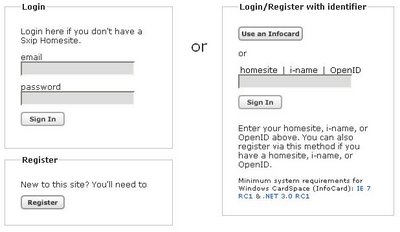 I guess the user would see the same interface at any other site that implemented Whobar.
Note: the use of 'Homesite' on the left, while perhaps appropriate for Sxore, seems to tie it too closely to Sxip for the general case? I wonder if this is configurable?
The above pic hilites the usability challenge of how to present log-in and/or registration options to a user. I'm no UI designer but have to question whether the above is optimal. As the number of options for logging-in grows, and the opportunity for confused users grows accordingly, maybe we need to separate out the possibility of registration, rather than intermixing the two as the above does?
Whatever does turn out to be the best (in the sense of minimizing user confusion) interaction solution, the Whobar model could make practical the reproduction of that sequence across sites.
This pic shows Whobar in action at Sxore.
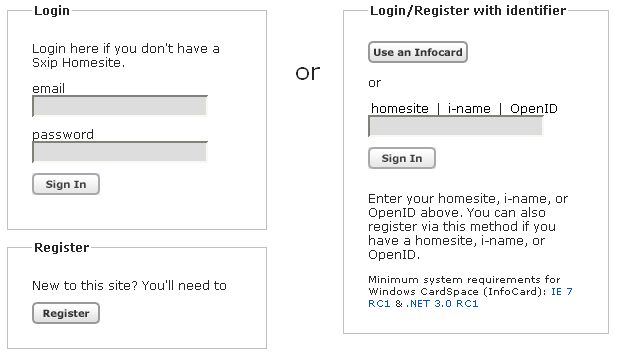 I guess the user would see the same interface at any other site that implemented Whobar.
Note: the use of 'Homesite' on the left, while perhaps appropriate for Sxore, seems to tie it too closely to Sxip for the general case? I wonder if this is configurable?
The above pic hilites the usability challenge of how to present log-in and/or registration options to a user. I'm no UI designer but have to question whether the above is optimal. As the number of options for logging-in grows, and the opportunity for confused users grows accordingly, maybe we need to separate out the possibility of registration, rather than intermixing the two as the above does?
Whatever does turn out to be the best (in the sense of minimizing user confusion) interaction solution, the Whobar model could make practical the reproduction of that sequence across sites.
Ping Cardspace implementation oddity
I used Chuck Mortimore's Firefox extension to present a self-asserted card to Ping's IDP, which, after doing the Cardspace dance, displayed the following on the IDP portal page.
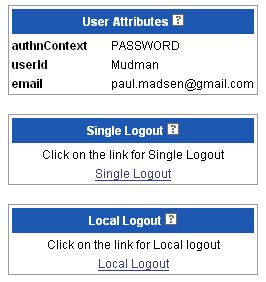
It's the 'PASSWORD' as authentication context that confuses me.
I didn't authenticate to the IDP with a password, I did so with Cardspace. More precisely, I authenticated to the IDP (acting as a Cardspace RP) by proving I had a key through an XML-Signature. So, strictly speaking, the appropriate SAML Authentication Context class should be 'XML Signature'.
A Cardspace user will sometimes be required to authenticate with a pin or similar to a local key store (and so it could be conceivable that there would be a password in the mix). In such cases, just saying 'XML Signature' wouldn't adequately describe the authentication context. The options would appear to be to use combinations of existing AC class URIs or define new SAML AC class defined specific to Cardspace.
Update: Patrick Harding reminded me that Cardspace uses SAML 1.1 so doesn't have the full expressiveness of SAML 2.0's Authentication Context available. The conjecture is that Ping's Ashish Jain, because of this lack of expressiveness, had to fall back on 'password'.

It's the 'PASSWORD' as authentication context that confuses me.
I didn't authenticate to the IDP with a password, I did so with Cardspace. More precisely, I authenticated to the IDP (acting as a Cardspace RP) by proving I had a key through an XML-Signature. So, strictly speaking, the appropriate SAML Authentication Context class should be 'XML Signature'.
A Cardspace user will sometimes be required to authenticate with a pin or similar to a local key store (and so it could be conceivable that there would be a password in the mix). In such cases, just saying 'XML Signature' wouldn't adequately describe the authentication context. The options would appear to be to use combinations of existing AC class URIs or define new SAML AC class defined specific to Cardspace.
Update: Patrick Harding reminded me that Cardspace uses SAML 1.1 so doesn't have the full expressiveness of SAML 2.0's Authentication Context available. The conjecture is that Ping's Ashish Jain, because of this lack of expressiveness, had to fall back on 'password'.
Sunday, October 01, 2006
Saturday, September 30, 2006
Conor's Bi (directional argument)
I'm sure he would have preferred to actually get in and invoke 'editorial privileges' to modify my post but Conor has settled for a response.
SP: Dear IDP, when I communicate with you I will use the 'abc' identifier (in the NameID) that you created for me.
IDP: Dear SP, when I communicate with you I will use the 'def' identifier (in the SPProvidedID) that you created for me.
The question is, does this commitment still apply when the two providers switch roles?
Conor will argue that the initial commitment is more along the lines of:
SP: Dear IDP, when I (acting as an SP) communicate with you I will use the 'abc' identifier (in the NameID) that you created for me. When however I (acting as an IDP) might communicate with you, I will use the 'def' identifier (in the NameID) that I created for you.
IDP: Dear SP, when I (acting as an IDP) communicate with you I will use the 'def' identifier (in the SPProvidedID) that you created for me. When however I (acting as an SP) might communicate with you, I will use the 'abc' identifier that I created for you.
I don't know which it is (and don't really care). I just don't believe its straighforward to infer the right choice from the specs.
I wasn't arguing that the Former-SP-Now-Acting-As-An-IDP should insert the null string, but rather that consistency with the double identifier case as he laid it out forced it to. More precisely, consistency with the double identifier case required it to insert the identifier previously created by the Former-IdP-Now-Acting-As-An-SP in the SPProvidedID attribute, and that it had no other identifier to place in the NameID element - thus 'null'.
So, consistency between the single and double identifier cases breaks SAML (as SAML doesn't define a null.
Reductio ad absurdum.
While I'll admit there's a certain level of consistency to Paul's proposal, I still think that the right way is to put the identifier in the NameID value rather than the SPProvidedID. My reasons include:
The other interpretation is that, when playing their initial roles, the SP and IDP made the following commitment to each other:* The NameID carries the value chosen by the "IdP" to represent the user at the "SP". In this case, the Former-SP-Now-Acting-As-An-IdP has chosen to use the identifier that it had received from the Former-IdP-Now-Acting-As-An-SP. Therefore that value belongs in the NameID elementnot in the SPProvidedID attribute.
SP: Dear IDP, when I communicate with you I will use the 'abc' identifier (in the NameID) that you created for me.
IDP: Dear SP, when I communicate with you I will use the 'def' identifier (in the SPProvidedID) that you created for me.
The question is, does this commitment still apply when the two providers switch roles?
Conor will argue that the initial commitment is more along the lines of:
SP: Dear IDP, when I (acting as an SP) communicate with you I will use the 'abc' identifier (in the NameID) that you created for me. When however I (acting as an IDP) might communicate with you, I will use the 'def' identifier (in the NameID) that I created for you.
IDP: Dear SP, when I (acting as an IDP) communicate with you I will use the 'def' identifier (in the SPProvidedID) that you created for me. When however I (acting as an SP) might communicate with you, I will use the 'abc' identifier that I created for you.
I don't know which it is (and don't really care). I just don't believe its straighforward to infer the right choice from the specs.
* The SAML 2.0 Core Specification does not allow for a null value in a persistent identifier (see section 8.3.7).
I wasn't arguing that the Former-SP-Now-Acting-As-An-IDP should insert the null string, but rather that consistency with the double identifier case as he laid it out forced it to. More precisely, consistency with the double identifier case required it to insert the identifier previously created by the Former-IdP-Now-Acting-As-An-SP in the SPProvidedID attribute, and that it had no other identifier to place in the NameID element - thus 'null'.
So, consistency between the single and double identifier cases breaks SAML (as SAML doesn't define a null.
Reductio ad absurdum.
As I read them, these two paragraphs from the SAML spec require that the Former-SP-Now-Acting-As-An-IDP, if they use an identifier initially created by the Former-IDP-Now-Acting-As-An-SP, to use the NameQualifier attribute. So, the example from my first response was incorrect, it should have been* Lines 3326-3332 and 3350-3356 of the SAML 2.0 Core Specification actually discuss the case of an SP using the same identifier provided to it by an IdP when that SP-now-acting-an-IdP issues assertions pointing out that they would need to identify the original issuing party using the NameQualifier attribute.
<saml2:NameID Format="persistent" SPProvidedID="def" NameQualifer="IDP.com">Ironically, I believe that this sentence (Line 3352):
abc
</saml2:NameID>
If a service provider that receives such an identifier takes on the role of an identity provider and issues its own assertion containing that identifier, the NameQualifier attribute value does not change (and would of course not be omitted).supports my model as it implies that the SP, in a reverse assertion, would use (in the NameID element) the identifier previously created by the IDP, and not the identifier it has previously created.
Badges? we don't need no stinkin' badges
Friday, September 29, 2006
Never Say Never
I don't have quite the same amount of faith as Bavo De Ridder does in Liberty Alliance's new intro to our specification set.
I know I've heard 'recalculating' countless times from another system that makes the same claim.
I know I've heard 'recalculating' countless times from another system that makes the same claim.
Let your users do the walking
Wired has an article on how map data companies get their information. Assuming sufficiently accurate GPS data from a phone or PDA, they could get real-time data from users themselves.
Maybe everytime a user alerts the system to the status of a road changing, they get 50 cents off their morning coffee. Extra points for new road construction. You'd need a Karma-like reputation system or rely on duplicate reports.
Maybe everytime a user alerts the system to the status of a road changing, they get 50 cents off their morning coffee. Extra points for new road construction. You'd need a Karma-like reputation system or rely on duplicate reports.
When in Rome
I'm reading through the XDI.org OpenID Authentication Service, which profiles how to use XRI and OpenID together.
The initial document metadata leaves no doubt that this doc is coming from XRI enthusiasts/advocates.
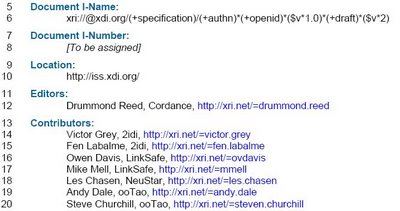 Fair enough, they are eating their own dogfood (no pejorative connotation intended).
Interestingly, although Drummond Reed is also an editor of the comparable document profiling how XRI and SAML can be composed (XDI SAML Authentication Service), in that document's metadata, he goes by just plain ol' 'Drummond Reed, Cordance'.
Drummond appears to be managing his identity just fine - choosing the right persona for the particular context. And he's not even using desktop software.
The initial document metadata leaves no doubt that this doc is coming from XRI enthusiasts/advocates.
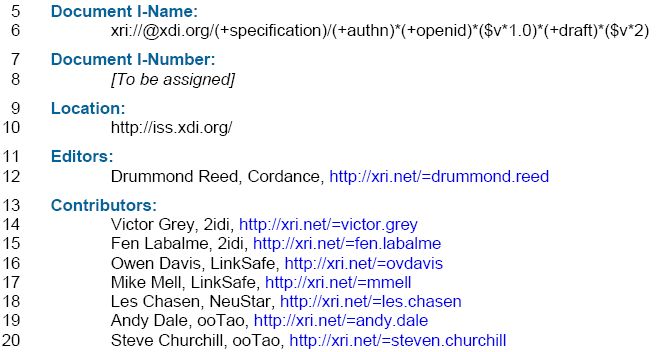 Fair enough, they are eating their own dogfood (no pejorative connotation intended).
Interestingly, although Drummond Reed is also an editor of the comparable document profiling how XRI and SAML can be composed (XDI SAML Authentication Service), in that document's metadata, he goes by just plain ol' 'Drummond Reed, Cordance'.
Drummond appears to be managing his identity just fine - choosing the right persona for the particular context. And he's not even using desktop software.
Thursday, September 28, 2006
Give me a 'P'!
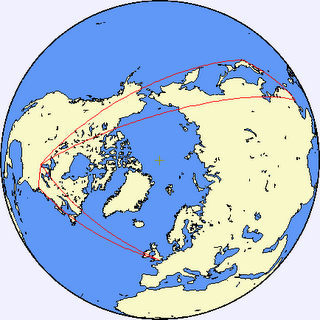
A certain unnamed business class traveller alerted me to the fact that, if you closed one eye and leaned sideways, his upcoming travel itinerary spelled out a 'C' when mapped onto the globe.
I hereby vow to fly IAD-SFO-YVR-YYC-DEN-SFO before I die.
Bi-directional federation in SAML
Conor proposes a model by which the federated identifier(s) established in one "direction" can be made to serve double duty in the other direction.
For instance, if an IDP and SP agree to use 'abc' whenever they communicate in order to refer to a particular user (either in an IDP Response or some SP message), then that same identifier could be used were the two to switch roles. So, if the SP (acting as an IDP) were to issue an Assertion for the user in question, the SP would use 'abc' in its NameID rather than some other identifier that the two providers might feel the need to establish for this direction).
Seems to make sense.
But if, instead of there being a single federated identifier 'abc' for the user between the two providers, as will happen if the SP avails itself of its right to specify 'def' as the identifier (called the SPProvidedID) it desires the IDP use when referring to the user, then things don't seem as clear.
Conor recommends that, in this case, when the SP switches roles and creates an Assertion for the user to be delivered to the IDP, the SP also effectively switch identifiers, and use that identifier it previously specified as the SPProvidedID as the primary identifier. So, the NameID of the reverse direction Assertion would look like
Problem is, I think the alternative option, in which providers, once they've agreed upon an identifier(s) to use, use that identifier regardless of the roles they may find themselves playing in the future. In this case, because the two providers initially agreed that, when communicating from the SP to the IDP, the 'abc' identifier is the right one to use, the SP would do just that in its Assertion to the IDP. Consequently, the NameID would be the mirror image of the above
Conor appears to acknowledge the choice, as he writes:
For instance, if an IDP and SP agree to use 'abc' whenever they communicate in order to refer to a particular user (either in an IDP Response
Seems to make sense.
But if, instead of there being a single federated identifier 'abc' for the user between the two providers, as will happen if the SP avails itself of its right to specify 'def' as the identifier (called the SPProvidedID) it desires the IDP use when referring to the user, then things don't seem as clear.
Conor recommends that, in this case, when the SP switches roles and creates an Assertion for the user to be delivered to the IDP, the SP also effectively switch identifiers, and use that identifier it previously specified as the SPProvidedID as the primary identifier. So, the NameID of the reverse direction Assertion would look like
<saml2:NameID Format="persistent" SPProvidedID="abc">This model can be justified because the 'abc' identifier was initially generated by the IDP (but now consuming it playing the role of an SP). So, placing it in the SPProvidedID attribute makes sense. In this model, providers use the identifiers appropriate to whatever current role they are playing, rather than whatever role they might have been playing when the id was established.
def
</saml2:NameID>
Problem is, I think the alternative option, in which providers, once they've agreed upon an identifier(s) to use, use that identifier regardless of the roles they may find themselves playing in the future. In this case, because the two providers initially agreed that, when communicating from the SP to the IDP, the 'abc' identifier is the right one to use, the SP would do just that in its Assertion to the IDP. Consequently, the NameID would be the mirror image of the above
<saml2:NameID Format="persistent" SPProvidedID="def">There is I think justification for this model in trying to stay consistent with the case where there is only the single 'abc' identifier. For this case, to be consistent with the model where the choice (and location) of an identifier is determined by the current role of the provider using it, then the NameID in the reverse direction would necessarily appear as:
abc
</saml2:NameID>
<saml2:NameID Format="persistent" SPProvidedID="abc">As it was the IDP that originally created the 'abc' identifier, then (when acting as an SP) that identifier needs to appear in the SPProvidedID attribute of the reverse Assertion (phew, say that 5 times fast). And, because the SP had never generated its own identifier to give to the IDP, it has to insert 'null' as the value of the NameID element. But, the above is different than what Conor proposes for this simple single identifier case.
null
</saml2:NameID>
Conor appears to acknowledge the choice, as he writes:
With that minor understanding, the remaining SAML 2.0 profiles, including Browser SSO, all work out-of the box bi-directionally.
Tokyo Liberty Alliance Day 2006
I'm looking forward to participating in the Liberty Alliance Day 2006 in Tokyo on October 30th. I'll be presenting the Liberty Alliance People Service.
I have to work in the 'Web 2.0' theme/meme into my existing material. Liberal sprinklings of 'mashup' and 'remix' should get me close. Must remember to get a 'long-tail' graphic.
I'm not looking forward to the air travel for this trip quite so much (I did have the option of a much shorter itinerary but couldn't resist the somewhat toroidal shape of this set of flights).
Taking pictures of the various economy traytables I will be sitting behind will consume, oh perhaps, 1 minute of the total 40 hours of flying time. No matter, I find the pain from my knees hitting the aformentioned seat backs makes the time just fly by.
I have to work in the 'Web 2.0' theme/meme into my existing material. Liberal sprinklings of 'mashup' and 'remix' should get me close. Must remember to get a 'long-tail' graphic.
I'm not looking forward to the air travel for this trip quite so much (I did have the option of a much shorter itinerary but couldn't resist the somewhat toroidal shape of this set of flights).
Taking pictures of the various economy traytables I will be sitting behind will consume, oh perhaps, 1 minute of the total 40 hours of flying time. No matter, I find the pain from my knees hitting the aformentioned seat backs makes the time just fly by.
FutureShock
FutureMe allows people to send email messages to themselves at some designated time in the future. Depending on how far forward into the future the send time is set, it's either a reminder service or a personalized time capsule service.
The FAQ attempts to address a fundamental issue with the time-capsule model:
When I signed up for an account (Conor, do these sort of test accounts count towards my total?) I specified an email address (which was not verified). When I attempted to use the system to send a future message, I provided a different address to see if I would be allowed. I was. Consequently, I can send into the future helpful 'reminders' to my friends and colleagues.
Examples might include 'Hey, if you owe Paul any money it's time to pay up' or 'Are you still taking credit for the work of your Liberty Alliance colleagues?". Endless fun ahead for me.
Unrelated, I love the disengenuity of the following:
The FAQ attempts to address a fundamental issue with the time-capsule model:
I expect the XRI people would have something to say about this.
but what if i don't have the same e-mail address in the future?
a possibility for sure. we recommend using an address with some potential for longevity (hotmail, yahoo, your own domain). in addition, we created a account management system so that you can change the addresses of your future letters. (though that's kind of cheating.)
When I signed up for an account (Conor, do these sort of test accounts count towards my total?) I specified an email address (which was not verified). When I attempted to use the system to send a future message, I provided a different address to see if I would be allowed. I was. Consequently, I can send into the future helpful 'reminders' to my friends and colleagues.
Examples might include 'Hey, if you owe Paul any money it's time to pay up' or 'Are you still taking credit for the work of your Liberty Alliance colleagues?". Endless fun ahead for me.
Unrelated, I love the disengenuity of the following:
how can i make a cash payment to said fellas for providing such a nifty service?Fair enough except for this from the privacy policy:
we're glad you asked. we've set up an amazon honor system thing. it's fresh. you can use paypal too if you'd prefer. they take less money away. see, if you donate a tiny amount of money, we spend less of our money. FutureMe is a free service and will remain so, but it does cost us a bit of cash to maintain the site and ensure proper delivery of your so-very-precious future letters.
So, while we are waiting for the book royalties to come in we'd appreciate some micro-love sent our way.
it is important to recognize that "public letters" submitted on FutureMe.org become solely the property of FutureMe.org. FutureMe.org reserves the right to edit and reproduce any "public letters" as the sole copyright holder (i.e. we're putting together a book and it's very exciting).
Wednesday, September 27, 2006
Identity systems as fried pastries

Pete (like Mark before him) jumps on the toroidal shape I used to depict the "spatial scope" of identity systems.
All I can say is that these shapes, misleading as they may be, are better than my first attempts at 3D drawing.
Speaking of Canadian pastries, Tim Hortons sells Timbits, tiny 'bite-sized' donuts. Timbits are sometimes presented (by me at least) as the remnants of the donut manufacturing process - the mythical 'bit' from the middle that would be otherwise discarded.
An offering of questionable value and necessity made viable by positioning in opposition to a well-established existing solution - purportedly filling holes in these existing alternatives? I'm just glad the identity standards industry is beyond such shenanigans.
Tuesday, September 26, 2006
There has to be an identity analogy
From Boing Boing, a mechanism for ensuring the security of checked luggage.
What could you put in a SAML Assertion to ensure that nobody would try to peek inside? Maybe Bush's inaugural speech? Village People lyrics?
I know a Base-64 encoded pic of Celine Dion would keep me and 25 million Canadians out.
What could you put in a SAML Assertion to ensure that nobody would try to peek inside? Maybe Bush's inaugural speech? Village People lyrics?
I know a Base-64 encoded pic of Celine Dion would keep me and 25 million Canadians out.
Liberty Alliance top ground
Pam had previously pointed out the deficiencies with the Liberty Alliance Web site, implicitly asking 'Where's the Beef?'.
At the time, I hinted that a new version of the Liberty Alliance site was coming that would hopefully address the concerns she raised. Well it came.
Worth noting in the new site:
At the time, I hinted that a new version of the Liberty Alliance site was coming that would hopefully address the concerns she raised. Well it came.
Worth noting in the new site:
- A search that actually appears to find appropriate items (although I question the relevance of a search based on ini files? )
- A 'Public Community' page for both member and non-member use (account required, how ironic)
- A snazzy Flash graphic as a navigator for the specifications and hopefully helps to address the 'Liberty Alliance as PDF publishing engine" issue
Monday, September 25, 2006
2d is just sooo last year
My friend Patrick Harding from Ping ID has blogged a nice graphic in which he plots various identity protocols onto a 2D grid.
I question the boundaries and positioning of many of Patrick's ellipses:
Consequently, below is a plot for the SAML 2.0 Enhanced Client Profile (ECP), distinguished by:

By any definition I've seen, SAML ECP is user-centric and so, at minimum, the SAML ellipse in Patrick's diagram should be streched to the right (and a separate, much smaller, ellipse created for WS-Fed, maybe used a dotted line).
I question the boundaries and positioning of many of Patrick's ellipses:
- SAML's ability to cover the user-centric use cases is minimized.
- Cardspace's relevance to the enterprise is marginalized.
- Managed Cardspace is shown as enabling more valuable transactions than SAML.
- Liberty WSF isn't shown.
- The extreme of the 'user-centricity' axis is typified by 'self-asserted identity (suggesting to me that 3rd party asserted identity is somehow incompatible with "pure" user-centrism)
Consequently, below is a plot for the SAML 2.0 Enhanced Client Profile (ECP), distinguished by:
- how identity flows 'through' the user agent and thereby enables direct control by the user
- the possibility of an asymmetric relationship between the SP and the IDP (as the client can mediate)

By any definition I've seen, SAML ECP is user-centric and so, at minimum, the SAML ellipse in Patrick's diagram should be streched to the right (and a separate, much smaller, ellipse created for WS-Fed, maybe used a dotted line).
Saturday, September 23, 2006
An apt description of our relationship
Conor giving me a hard time (in his own words).
I have to stop blogging about him. He's like a sore tooth that you can't help probing.
With my choice of words for that last sentence, and knowing how his minds works, I do realize I have guaranteed myself a follow up.
I have to stop blogging about him. He's like a sore tooth that you can't help probing.
With my choice of words for that last sentence, and knowing how his minds works, I do realize I have guaranteed myself a follow up.
Friday, September 22, 2006
Nonage
I've been really happy with my Vonage VoIP service. So, I was willing to fill out a survey to which they sent me a link (the promised $5 discount helped) even it was presented by a 3rd party named Intellicontact.
I was giving Vonage high points with my answers ... until I saw the last two requests for info.
 On some machine at Intellicontact, a process lies dormant, patiently waiting for survey data to be submitted.
I was giving Vonage high points with my answers ... until I saw the last two requests for info.
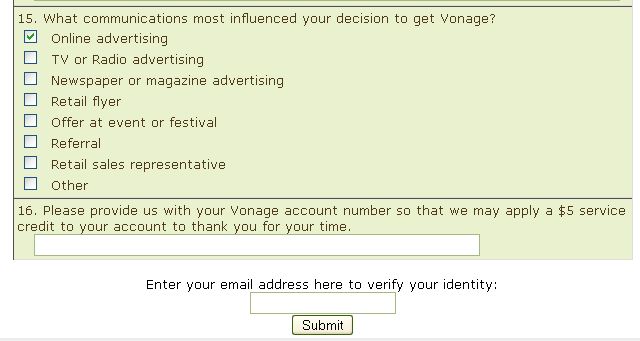 On some machine at Intellicontact, a process lies dormant, patiently waiting for survey data to be submitted.
I won't give away the ending
There is a line in Lucky Number Slevin (an excellent movie by the way) in which the Rabbi says:
Names, even made up ones, can bring about quite a bit of trouble.This reads like a line from a Liberty best practices document.
Thursday, September 21, 2006
Definition of Serendipity
Notwithstanding the excellent food & drink, getting together with Liberty friends, nice progress on our specification development, and interesting demonstrations and feedback from a number of Liberty implementations, this on its own would have made my trip to Paris all worthwhile.
New French Smoking Laws

Compared to my last visit to Paris 4 years ago, it seems that France has relaxed its smoking laws.
What had been a MUST (as in 'everybody MUST smoke') appears to have been loosened to a SHOULD.
Wednesday, September 20, 2006
That's not a knife
And neither is this much of an Eiffel Tower picture.
Now this is a picture of the Eiffel Tower.
 Conor's picture is derivative and bland, mine is innovative and daring. Much like how we go about our Liberty specification work. I expect that Conor will somehow now make mods to my picture, claiming 'Editor Prerogative'.
Now this is a picture of the Eiffel Tower.
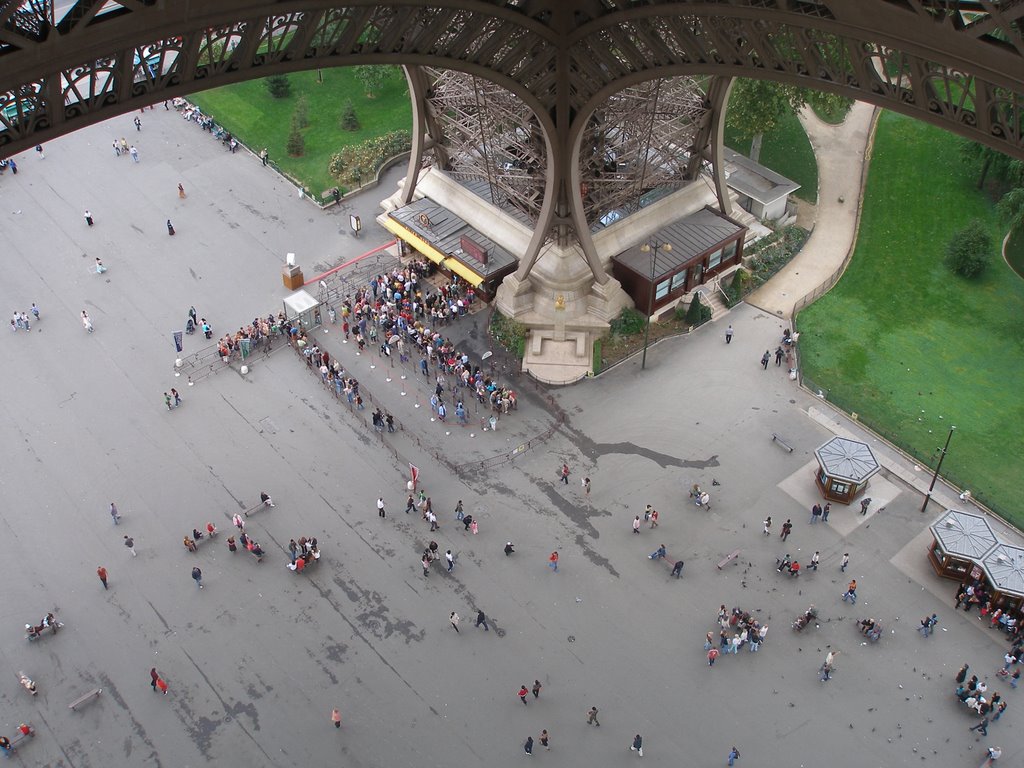 Conor's picture is derivative and bland, mine is innovative and daring. Much like how we go about our Liberty specification work. I expect that Conor will somehow now make mods to my picture, claiming 'Editor Prerogative'.
Saturday, September 16, 2006
I am at liberty to comment
 Or, more precisely, I will be at liberty to comment (and deride) in 3 days.
 The Liberty Alliance Technology Expert Group is meeting at France Telecom facilities in Paris.
Sync-ups with Egalite and Fraternite are planned.
Friday, September 15, 2006
My Frequent Flyer Sensei
Conor complains about a United miles promotion.
It's a tough call but I'd venture that Conor might have even more expertise and insight on the subject of business travel than he does on identity (although he does get 'awards' in both domains).
Amazingly, he is also equally opinionated in both. Do normal people care whether they sit on the left or right-hand side of the plane? Conor appears to (and I bet he has statistics to justify his preference).
It's a tough call but I'd venture that Conor might have even more expertise and insight on the subject of business travel than he does on identity (although he does get 'awards' in both domains).
Amazingly, he is also equally opinionated in both. Do normal people care whether they sit on the left or right-hand side of the plane? Conor appears to (and I bet he has statistics to justify his preference).
Thursday, September 14, 2006
They must want me to call them
I'm trying to reset a password on a site I don't use much and I see the following
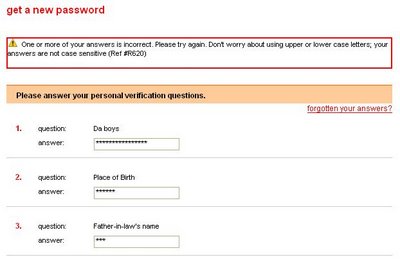
The Q&A would have been previously supplied by myself sometime ago.
Unfortunately, for each Q, there are a couple of possible A's that I might have provided. For instance, I was born in Moscow but maybe I entered 'Russia' or 'USSR'. Who knows. The same for the questions about names, did I enter full names or shorter versions?
So, since each Q has at least two variant A's, and they give no hints as to which A is wrong, the odds are 1 in 8 that I, the valid account holder, will be able to reset without calling them for help (or spending the time trying the permutations).
The help desk staff must have a strong union protecting themselves from redundancy layoffs.

The Q&A would have been previously supplied by myself sometime ago.
Unfortunately, for each Q, there are a couple of possible A's that I might have provided. For instance, I was born in Moscow but maybe I entered 'Russia' or 'USSR'. Who knows. The same for the questions about names, did I enter full names or shorter versions?
So, since each Q has at least two variant A's, and they give no hints as to which A is wrong, the odds are 1 in 8 that I, the valid account holder, will be able to reset without calling them for help (or spending the time trying the permutations).
The help desk staff must have a strong union protecting themselves from redundancy layoffs.
No visible signs of support
The virus scanning from my email provider has been flaky lately. When I asked for support, the message below was their response:
This is either the worst support response ever or a diabolically clever interactive phish.
The user has 2 pages of instructions thrown at them, the only one that they can easily perform is the 'provide user name and password' step. It's even first in the list to make sure Vern from Mattawa sees it. "Well jee wiz, why don't I do #1 and see how that helps".
This is either the worst support response ever or a diabolically clever interactive phish.
The user has 2 pages of instructions thrown at them, the only one that they can easily perform is the 'provide user name and password' step. It's even first in the list to make sure Vern from Mattawa sees it. "Well jee wiz, why don't I do #1 and see how that helps".
Dear Paul Madsen,
Thank-you for your email. We strive to provide you with the highest level of customer support, and hope we can be of assistance in addressing your questions.
We understand your concern.
Please confirm the following so we can determine the source of the
problem:
1. Username and Password being used to download the software
2. Exact error message received and at what step in the process
3. Steps taken that led to this error and the step where the error is
occurring
4. Operating System and the version of the browser being used
5. Do you have any firewall software installed?
6. Any other anti-virus software installed prior to installing YOP and
has it been removed?
7. Please ensure that your proxies are disabled and that Active X is
enabled
8. Any changes were made on computer prior to the occurrence of the
issue (for example: Windows updates or software install/removal)
9. All information from WINIPCFG or IPCONFIG (PC IP,DNS Server IP's,
DHCP Server IP, Hostname, Nic mac address, Lease times)
========================================
For details on Active X, please refer to the URL shown below. Also, you
may refer to Microsoft at (905) 568-4494.
http://support.microsoft.com/default.aspx?scid=kb;en-us;154544
To turn proxies off using I.E.:
1) Click on TOOLS - INTERNET OPTIONS.
2) Click on the CONNECTION tab near the top of the window.
3) Click the LAN SETTINGS button.
4) Click the ADVANCED button.
5) Make sure that all of the address fields are clear and click on OK
6) A dialog box will appear asking if you do not want to use a proxy
server. This is normal - click on YES.
7) Click OK.
Your connection to the proxy server should now be disabled.
========================================
To view your IP configuration settings, run the 'winipcfg' utility
provided by Windows 95/98/ME. To do this, follow the steps below:
1. Click on START then RUN...
2. In the RUN... dialogue box, enter the following command:
'winipcfg' (without the quotations)
3. This will display an IP Configuration window. At the top of this
window, there is a drop down box that allows you to specify a hardware
device. Make sure you select your Ethernet Adapter (and not your PPP
adapter for instance).
4. Once you have selected your network card (your ethernet adapter),
your IP information will be displayed in the boxes below. Click the MORE
INFO button to view all the configuration information.
5. Once you have released and renewed your IP configuration, click OK to
close the IP Configuration window.
----------------------------------------
If you are running Win2000 or Win XP, you must first goto the command
prompt by following the options below:
1. Click START - RUN , and then type 'CMD' and press Enter.
2. At the command prompt, type "IPCONFIG /ALL" (to view IP address).
3. At the command prompt, type "IPCONFIG /RELEASE" (to release IP).
4. At the command prompt, type "IPCONFIG /RENEW" (to renew IP).
5. At the command prompt type "EXIT" (to exit back to the desktop).
========================================
In addition, please ensure that you have the following minimum system
requirements:
Windows 98SE, Windows 2000, or Windows XP
Internet Explorer 6.0 (or later) with ActiveX enabled or Rogers Yahoo!
Browser 3.0 (or later) with ActiveX enabled
350MB free hard disk space
RAM: 196MB for Windows 98SE and Windows 2000; 256MB for Windows XP
Network Access via Rogers Yahoo! for Broadband
To install further requires:
Administrator rights on intended computer
All other antivirus software must first be removed
If you have any further questions or comments regarding our service,
please fill out the online form on our Customer Support page listed
below or contact us by phone at ...
Regards,
Electronic Support Group
Thursday, September 07, 2006
Would it even things up
if I blogged only with my left hand?
I'm trying to think of ways by which I can give Conor a fair chance at approaching my blog readership lead (thanks for the link Mom!). His latest response convinces me that something is necessary.
So far, I've come up with the following possibilities
- switch the blog focus to fly fishing
- start a charity for the 'interesting challenged'
- pay neighborhood kids to create blogs that link to him
- vow to not use vowels in my posts
Wednesday, September 06, 2006
In the spirit of pointless bit flow
Jamie Murray (1973 - 2006)
I lost my brother-in-law and friend last week. As they say in the Ottawa Valley, he 'took a heart attack'. At 33 years of age. The world seems a whole lot more perverse than before.

I like to argue, learn new things, drink beer, and build things. Jamie was a willing and able partner in all these. He was also the best damn Uncle to my kids that could be spec'd out.

The doctors tell us it could have happened while he was pumping gas or filling out a Web form - neither a fitting end to a life of activity and love. Jamie died in his treasured boat after wake boarding on the river he loved, surrounded by the nieces and nephews that adored him, and close to his wife and family.
I will continue to argue, learn, drink beer and build sheds at the cottage. It just won't be as fun.

I like to argue, learn new things, drink beer, and build things. Jamie was a willing and able partner in all these. He was also the best damn Uncle to my kids that could be spec'd out.

The doctors tell us it could have happened while he was pumping gas or filling out a Web form - neither a fitting end to a life of activity and love. Jamie died in his treasured boat after wake boarding on the river he loved, surrounded by the nieces and nephews that adored him, and close to his wife and family.
I will continue to argue, learn, drink beer and build sheds at the cottage. It just won't be as fun.
My lead feels safe
In his first salvo of the 'Great Blog Readership War', Conor fires off
a) a stirring account of how he fixed his kitchen drawer.
b) a hard & driving story describing his purchase and plans for some computer equipment.
I expect we'll next hear about some problem with his farm tractor that he was able to repair with a USB cable and a patch made from chewed-up Cheerios paste.
Blatant attempt at targetted marketing for those searching on 'hardware'. He can have them - my readers pay their "people" to fix & install things. Much like the distinction between 'Jeopardy' and 'Who Wants to be a Millionaire' demographics.
I think I can safely take the week off from any further posts. Or the month. Maybe just start up again in January. I do need to ensure that I'm active before the Internet makes it to Ireland - Conor's numbers will jump when his relatives get online.
Note: I choose to believe that it was coincidence that Conor chose his blog address to begin with 'C O N' - the same three letters as does mine. Not intentional typo squatting I'm sure. I might have to revisit this opinion if Conor's metrics (number of linking blogs and Technorati rank) pass mine.
a) a stirring account of how he fixed his kitchen drawer.
b) a hard & driving story describing his purchase and plans for some computer equipment.
I expect we'll next hear about some problem with his farm tractor that he was able to repair with a USB cable and a patch made from chewed-up Cheerios paste.
Blatant attempt at targetted marketing for those searching on 'hardware'. He can have them - my readers pay their "people" to fix & install things. Much like the distinction between 'Jeopardy' and 'Who Wants to be a Millionaire' demographics.
I think I can safely take the week off from any further posts. Or the month. Maybe just start up again in January. I do need to ensure that I'm active before the Internet makes it to Ireland - Conor's numbers will jump when his relatives get online.
Note: I choose to believe that it was coincidence that Conor chose his blog address to begin with 'C O N' - the same three letters as does mine. Not intentional typo squatting I'm sure. I might have to revisit this opinion if Conor's metrics (number of linking blogs and Technorati rank) pass mine.
Thursday, August 31, 2006
Sometimes I want an account
I just signed my two sons up for hockey camp through an online registration.
I really appreciated having to enter all the same information twice - sometimes I tend to forget my home address and like to be reminded through rote repetition.
Given that I've signed them up in years past, and will be signing them up going forward (untill they come to the realization that they've inherited my skating ability), I would have preferred an account to store the info (in the near term absence of better alternatives).
I really appreciated having to enter all the same information twice - sometimes I tend to forget my home address and like to be reminded through rote repetition.
Given that I've signed them up in years past, and will be signing them up going forward (untill they come to the realization that they've inherited my skating ability), I would have preferred an account to store the info (in the near term absence of better alternatives).
Hospitality Industry Token Mapping
 Just returned from a trip down to Washington for a Liberty TEG meeting.
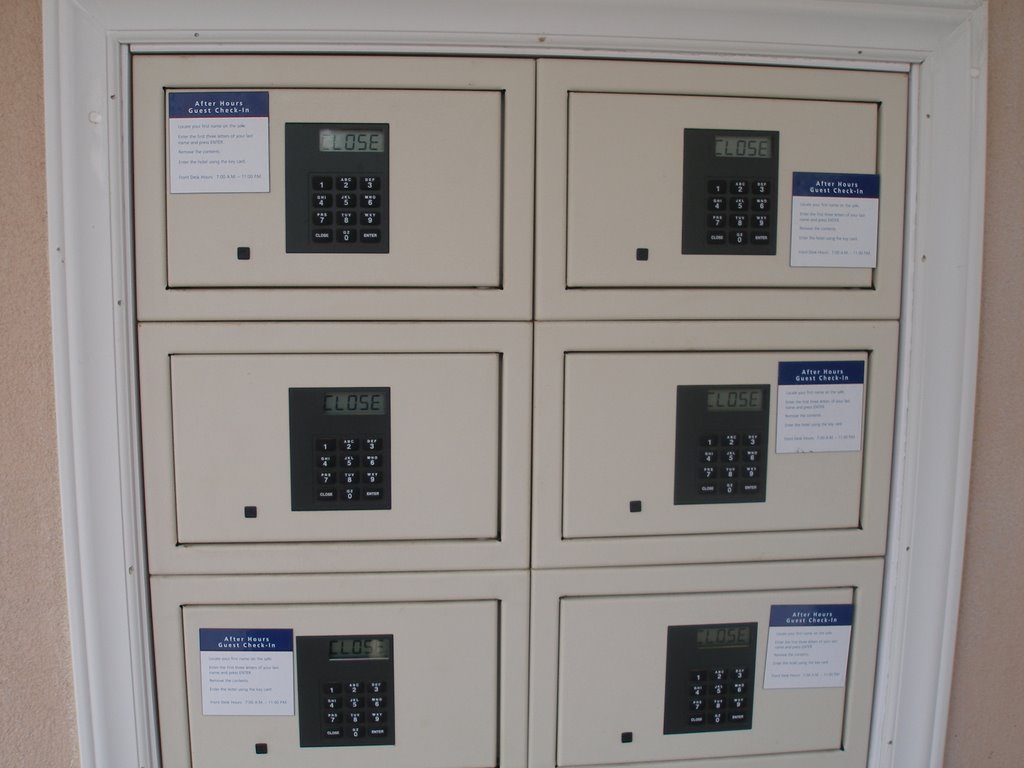
Leaving the hotel, my NTT colleague Hiroyoshi Takiguchi and I noticed what appeared to be a number of wall safes just outside the front door.
The safes are there for guests who arrive for check-in after the front desk closes at 11 pm. The mechanisms works as follows
1) Before leaving for the night, staff enters the first name of each expected guest into one of the displays
2) Guest, on arriving, enters their last name using the keypad of the appropriate (matching their first name) safe.
3) Safe lock opens, guest retrieves their room swipe key.
4) Guest uses key to enter building and then their room.
5) Hotel staff sleep throughout.
So what if two guests have the same first name ....?
Or if a guest has an easily guessed last name ..?
Or hotel staff mistypes the guest's last name ..? (comparable to somebody, in a fit of pique arrising from poor blog readership, spelling 'Madsooon')
Speaking of pique, Conor suggested that a better model would be for the guest to simply swipe the credit card used to make the booking - that would imply connectivity beyond the safe unit itself.
Nice example of token mapping. The guest exchanges one token (their last name) for another that can be used to access local resources (ie. enter the hotel and room).
Dulles Dialogue
Cast of Characters
- Security Screener at Washington Dulles Airport (SSWDA)
- Guy in Front of Me in Line Going Through Security (GFMLGTS)
- Paul
Scene1
SSWDA: (to GFML as he peers at his scanner screen) So, is this a laptop or a DVD player?
GFMLGTS: I'm in the military and it's classified.
SSWDA: Pardon me?
GFMLGTS: I can't tell you what it is in public.
SSWDA: Supervisor!
Exit Paul. stage left, scurrying over to other line
Tuesday, August 29, 2006
Id (in the Freudian sense)-Centric
Chris Ceppi proposes a new addition to the taxonomy - Ego Centric identity.
Note: The last confuses me, in what sense is the ID Gang an 'asserting party'?
In my opinion, any taxonomy that allows for the 'Ego' but doesn't acknowledge the importance of the 'Id' is lacking.
According to Freud, the Id is that part of the psyche that deals exclusively with the needs of the individual - the Id doesn't care about anything else. It's all me me me.
Sounds super. Consequently, I propose here
Id-centric - a model of identity management in which the user's desires and wishes come before all other factors (business realities, regulations,technical limitations, etc).
* Ego is participant in the ego centric model.
* Claim is statement made by an ego taking credit for an idea. A Claim can be made NotBefore and/or NotOnOrAfter an idea becomes well known.
* Assertion is statement made by an ego either directly or indirectly suggesting the superiority of the subject.
* Subject is always the ego.
* Asserting Party is a gathering of two or more egos to facilitate the exchange of claims and assertions. May be phyiscal or virtual.
Note: The last confuses me, in what sense is the ID Gang an 'asserting party'?
In my opinion, any taxonomy that allows for the 'Ego' but doesn't acknowledge the importance of the 'Id' is lacking.
According to Freud, the Id is that part of the psyche that deals exclusively with the needs of the individual - the Id doesn't care about anything else. It's all me me me.
Sounds super. Consequently, I propose here
Id-centric - a model of identity management in which the user's desires and wishes come before all other factors (business realities, regulations,technical limitations, etc).
Just ask my wife
Apparently, the Japanese government is funding research on automated mechanisms to help surfers assess the validity of online information they read.
Science seems to be missing an obvious resource
Me: I need a new MP3 player
Wife: Bullsh*t!
Me: I couldn't get an earlier flight home from Hawaii
Wife: Bullsh*t!
Me: I read it for the articles
Wife: Bullsh*t!
Science seems to be missing an obvious resource
Me: I need a new MP3 player
Wife: Bullsh*t!
Me: I couldn't get an earlier flight home from Hawaii
Wife: Bullsh*t!
Me: I read it for the articles
Wife: Bullsh*t!
Monday, August 28, 2006
Name management
Neighbours across the street prefer that our kids to refer to them as 'Mr & Mrs X'. As this is diferent than the pattern of others in the neighborhood (where first names are just fine), my kids occasionally ask about it. I always respond that everybody has the right to choose what name they want other people to use for them.
Kaliya wants to be known as 'Identity Woman'.
Kaliya sees a bias against such titles
"Positional Titles" (as Kaliya describes them) are typically names given to us by somebody (a boss) or something (a corporation, a coach, etc) else and, as such, present a different set of criteria for assessing validity than self-asserted claims.
There is of course supporting evidence that lends creedence to Kaliya's chosen moniker (her resume, her history of unconferences facilitated, opinions of colleagues, her Canadianness, etc). It would be hard to get all that across to a conference attendee when reading a list of speakers.
Kaliya wants to be known as 'Identity Woman'.
Kaliya sees a bias against such titles
I find it interesting there is such a focus on that positional title to have legitimacy in this industry. I really think it is a disservice all around there are people who contribute a lot without positional ‘titles’ who deserve to be on stage some times perhaps more then those on stage who have ‘titles’.This to me reflects the distinction between self and 3rd-party asserted identity. It's easy to make claims about yourself - but sometimes relying parties want 3rd party assertions.
"Positional Titles" (as Kaliya describes them) are typically names given to us by somebody (a boss) or something (a corporation, a coach, etc) else and, as such, present a different set of criteria for assessing validity than self-asserted claims.
There is of course supporting evidence that lends creedence to Kaliya's chosen moniker (her resume, her history of unconferences facilitated, opinions of colleagues, her Canadianness, etc). It would be hard to get all that across to a conference attendee when reading a list of speakers.
Friday, August 25, 2006
Wednesday, August 23, 2006
QR-Codes for personal identity
In a comment to my post on the Identity Card Concept Project, Roger brought to my attention an application of QR-codes for identity.
Currently, QR-codes are typically used to bridge between the real-world and the digital-world, e.g. a user will use a reader in their phone to scan a paper flyer's QR-code with an embedded discount coupon. They can then use that coupon for an electronic purchase. The QR-code prevents them from having to type in some ugly URL printed on the flyer.
A similar application for identity would have a QR-code printed on my business or name card. The QR-code would facilitate the extraction of the identity into digital form without typing, like OCR but with capacity beyond the text actually printed on the card.
Kaywa's identity application of QR-codes, as shown at Roger's identity page, is interesting as the QR-code is displayed on the screen and not on a paper card (although it still could be). Rather than scanning a business card, your potential contact would use their phone scanner to scan the code from either their screen (while reading your blog etc) or your phone (when face-to-face). Scanning the QR-code bridges the "air gap" between two digital channels in a way that microformats etc can't do (but Infrared can, so perhaps an advantage of the QR-code scanning model is the improved privacy from not broadcasting?).
AFAICT, Japan is leading the way with respect to new uses of QR-codes. I know I've seen some very interesting applications for identity on my visits back to the NTT Mothership.
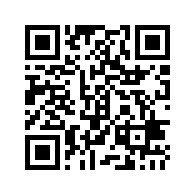 Extra points for decoding this.
Currently, QR-codes are typically used to bridge between the real-world and the digital-world, e.g. a user will use a reader in their phone to scan a paper flyer's QR-code with an embedded discount coupon. They can then use that coupon for an electronic purchase. The QR-code prevents them from having to type in some ugly URL printed on the flyer.
A similar application for identity would have a QR-code printed on my business or name card. The QR-code would facilitate the extraction of the identity into digital form without typing, like OCR but with capacity beyond the text actually printed on the card.
Kaywa's identity application of QR-codes, as shown at Roger's identity page, is interesting as the QR-code is displayed on the screen and not on a paper card (although it still could be). Rather than scanning a business card, your potential contact would use their phone scanner to scan the code from either their screen (while reading your blog etc) or your phone (when face-to-face). Scanning the QR-code bridges the "air gap" between two digital channels in a way that microformats etc can't do (but Infrared can, so perhaps an advantage of the QR-code scanning model is the improved privacy from not broadcasting?).
AFAICT, Japan is leading the way with respect to new uses of QR-codes. I know I've seen some very interesting applications for identity on my visits back to the NTT Mothership.
 Extra points for decoding this.
TrackMeNot
TrackMeNot is a Firefox extension that clouds your search history to the major engines with multiple fake searches - the "swamp with noise" model for privacy.
Here is the log of some random queries the extension made on my behalf
Well this isn't going to help.
Here is the log of some random queries the extension made on my behalf
*** Log started at Wed, 23 Aug 2006 11:00:49 GMT ***
[ACTION] type: saveOptions=true | Wed, 23 Aug 2006 11:00:49 GMT
[QUERY] engine=google | query='user centric' | 200 | Wed, 23 Aug 2006 11:00:50 GMT
[QUERY] engine=google | query='whatis user-centric' | 200 | Wed, 23 Aug 2006 11:00:52GMT
[QUERY] engine=google | query='defn user-centric' | 200 | Wed, 23 Aug 2006 11:00:53 GMT
[QUERY] engine=google | query='consistent defn user-centric' | 200 | Wed, 23 Aug 2006 11:00:54 GMT
[QUERY] engine=google | query='paul madsen' | 200 | Wed, 23 Aug 2006 11:01:03 GMT
[QUERY] engine=google | query='paul madsen' | 200 | Wed, 23 Aug 2006 11:01:04 GMT
[QUERY] engine=google | query='paul madsen' | 200 | Wed, 23 Aug 2006 11:01:05 GMT
[QUERY] engine=google | query='paul madsen' | 200 | Wed, 23 Aug 2006 11:01:06 GMT
[QUERY] engine=google | query='feel insecure' | 200 | Wed, 23 Aug 2006 11:01:07GMT
[QUERY] engine=google | query='paul madsen' | 200 | Wed, 23 Aug 2006 11:01:08 GMT
[QUERY] engine=google | query='ego surf' | 200 | Wed, 23 Aug 2006 11:01:09 GMT
[QUERY] engine=google | query='britney spears' | 200 | Wed, 23 Aug 2006 11:02:02 GMT
[QUERY] engine=google | query='hide searching' | 200 | Wed, 23 Aug 2006 11:03:03 GMT
[QUERY] engine=google | query='identity manage' | 200 | Wed, 23 Aug 2006 11:03:05 GMT
[QUERY] engine=google | query='halle swim' | 200 | Wed, 23 Aug 2006 11:04:06 GMT
[QUERY] engine=google | query='marriage help' | 200 | Wed, 23 Aug 2006 11:04:07 GMT
[QUERY] engine=google | query='data encryption' | 200 | Wed, 23 Aug 2006 11:04:08 GMT
[QUERY] engine=google | query='private eye' | 200 | Wed, 23 Aug 2006 11:04:09GMT
[QUERY] engine=google | query='divorce lawyer' | 200 | Wed, 23 Aug 2006 11:05:03 GMT
[QUERY] engine=google | query='child custody' | 200 | Wed, 23 Aug 2006 11:06:03 GMT
[QUERY] engine=google | query='dating tips' | 200 | Wed, 23 Aug 2006 11:07:03 GMT
[QUERY] engine=google | query='firm abs' | 200 | Wed, 23 Aug 2006 11:07:04 GMT
[QUERY] engine=google | query='viagra ' | 200 | Wed, 23 Aug 2006 11:07:06 GMT
[ACTION] type: showLog=true | Wed, 23 Aug 2006 11:02:24 GMT
Well this isn't going to help.
Tuesday, August 22, 2006
Dave, it's spelled 'B A N F F'
Dave Kearns commends Pam's article on Cardspace whilst deriding her province of residence.
The irony is of course that, at any one time, roughly half of the US population is skiing Alberta's hills.
It may just be that the climate in her home town is more conducive to deep thinking (after all, what else is there to do in Alberta?)
Passport (the other kind) Proxy
From Lifehacker, Make you own Passport proxy.
Proxy or forgery - tough call. Ultimately it would be in the eye of the beholder (the one with the gun who will likely tend to err on the side of a strict definition of validity).
A proxy for Passport, I thought that's what Windows Live ID was?
Proxy or forgery - tough call. Ultimately it would be in the eye of the beholder (the one with the gun who will likely tend to err on the side of a strict definition of validity).
A proxy for Passport, I thought that's what Windows Live ID was?
What fruit are you?
It seems that your 'Fruit Sign' is a new piece of identity that the various identity systems need account for in their profile schemas - or at least Dasani would have it that way.
Regardless of the results, I already know everything I need to know about anybody who actually spends the time taking such a quiz. "Oh my God, you're an Apple, so am I!"
Regardless of the results, I already know everything I need to know about anybody who actually spends the time taking such a quiz. "Oh my God, you're an Apple, so am I!"
OASIS IPR Rules for Dummies
The deadline by which existing OASIS Technical Committees must move to one of the three allowed IP modes is fast approaching.
I don't think I'm unique in having trouble understanding the differences between RAND, RF on RAND Terms, and RF on Limited Terms. I love to argue but that doesn't make me a lawyer.
I created the following table to help me. As I see it, the two most important parameters are whether or not the patent holder may be able to charge royalties, and whether or not any terms (other than royalties) are left open to possible negotiation between the patent holder and the licenses or explicitly called out. So, at its most basic (and surely glossing over important subtleties), a 2 by 2 table.
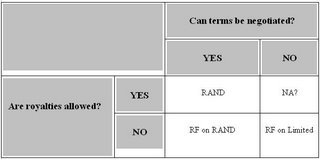
Does beg the question, why was RAND on Limited Terms ruled out?
And if you base any real business decision on this interpretation then the title is a good fit ...
Breaking News: I was very proud of this table. At least until I saw OASIS's version. I swear it wasn't there the last time I looked.
I don't think I'm unique in having trouble understanding the differences between RAND, RF on RAND Terms, and RF on Limited Terms. I love to argue but that doesn't make me a lawyer.
I created the following table to help me. As I see it, the two most important parameters are whether or not the patent holder may be able to charge royalties, and whether or not any terms (other than royalties) are left open to possible negotiation between the patent holder and the licenses or explicitly called out. So, at its most basic (and surely glossing over important subtleties), a 2 by 2 table.
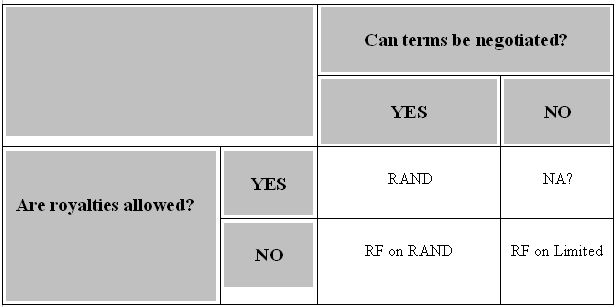
Does beg the question, why was RAND on Limited Terms ruled out?
And if you base any real business decision on this interpretation then the title is a good fit ...
Breaking News: I was very proud of this table. At least until I saw OASIS's version. I swear it wasn't there the last time I looked.
People Service Session at IOS
Apache's Ted Leung reports on the Vancouver IOS (I'm late, not him). He had the following to say on the session I led on the Liberty People Service.
Two comments:
1) I'm glad Ted got something useful out of the session - his criticism of the lack of an implementation is valid, hopefully the emerging Liberty Open Source initiative will address this.
2) I can't believe I looked this confused this early in the session - later sure but I've only drawn a single user at this point and I look stuck.
When I saw Kaliya Hamlin at Gnomedex, she told me about the Liberty People Service. This is the kind of thing that would be very useful to integrate into Chandler, so I made sure to attend Paul Madsen's session on the People Service. The session was dominated by technical content as people tried to understand how the service actually worked. Despite being unfamiliar with most of the Liberty specs, I found that I had no trouble following the discussion. I spent a year or so doing some consulting on the WS-* web services stack, and that experience made it possible to follow along. I had also read the People Service whitepaper. which probably also helped. I was disappointed to hear that there are no implementations (other than private prototypes) of the People Service that someone could get a hold of and play with. In this day and age, I expect a spec to be accompanied by a reference implementation or something. Maybe I've just been hanging out with the wrong people.
Two comments:
1) I'm glad Ted got something useful out of the session - his criticism of the lack of an implementation is valid, hopefully the emerging Liberty Open Source initiative will address this.
2) I can't believe I looked this confused this early in the session - later sure but I've only drawn a single user at this point and I look stuck.
Axes in Identity Space
I think there must be some sort of law (not an Identity Law) to the effect that 'Any real world complex phenomena/system can only be adequately modelled with 3 or more parameters'. Chaotic systems notwithstanding, it's typically an artificial simplification to force a model into 2 'dimensions' (e.g. Gartner's quadrants).
Identity systems are an example. They are sufficiently complex that to adequately model and differentiate different systems, three 'axes' seems the bare minimum (4 would be better but ...)
These three seem useful:
Axis 1 - Control Mechanimsms - whether the system enables the user with direct (in the flow) or indirect control (through defined policies enforced by a trusted 3rd party) over the release of their identity.
Axis 2 - Relationships - the nature of the relationship (e.g. trust, legal, etc) between the entity releasing some piece of identity and the entity consuming it. DIfferent systems assume different degrees of coupling.
Axis 3 - Identity - the nature of the identity being shared, e.g. is it an identifier for a subject or other less discriminating attributes.
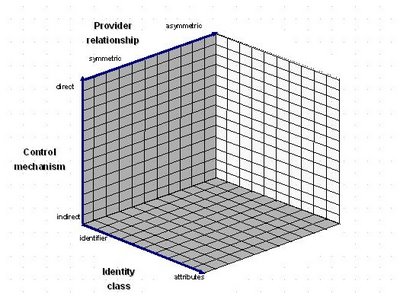
Different identity systems can be plotted against these co-ordinates. As an example, SAML's Web SSO Profile, when using persistent name identifiers and the HTTP Form POST Binding, can be characterized as:
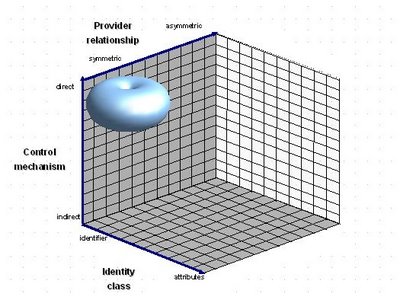 Others to follow.
Identity systems are an example. They are sufficiently complex that to adequately model and differentiate different systems, three 'axes' seems the bare minimum (4 would be better but ...)
These three seem useful:
Axis 1 - Control Mechanimsms - whether the system enables the user with direct (in the flow) or indirect control (through defined policies enforced by a trusted 3rd party) over the release of their identity.
Axis 2 - Relationships - the nature of the relationship (e.g. trust, legal, etc) between the entity releasing some piece of identity and the entity consuming it. DIfferent systems assume different degrees of coupling.
Axis 3 - Identity - the nature of the identity being shared, e.g. is it an identifier for a subject or other less discriminating attributes.
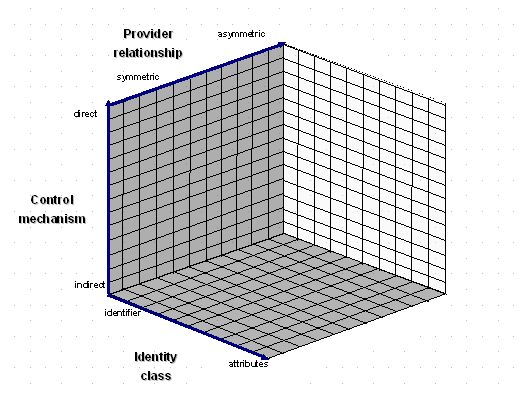
Different identity systems can be plotted against these co-ordinates. As an example, SAML's Web SSO Profile, when using persistent name identifiers and the HTTP Form POST Binding, can be characterized as:
- having the identity flow through the user-agent, and thereby enable direct user-control over its release
- typically sharing an identifier for the subject and not extra attributes (although possible)
- a symmetric relationship between Identity and Service Provider (the IDP 'knows' the SP as well as the opposite)
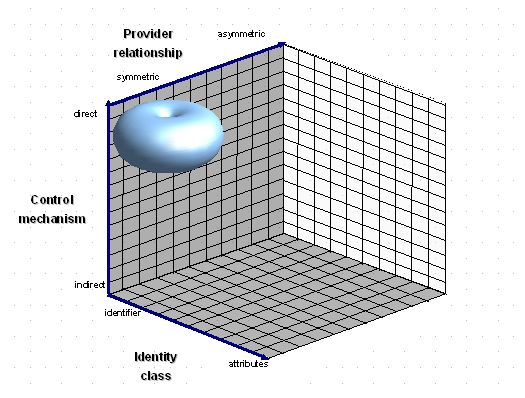 Others to follow.
Monday, August 21, 2006
Yahoo! Sign In Seal
Yahoo! has an anti-phishing mechanism called Sign-In Seal.
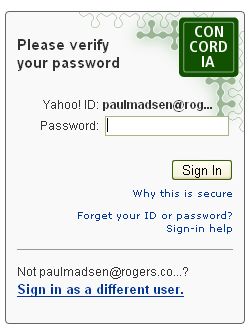
It's the little badge in the above, the text and colour of which I chose (private joke).
From the FAQ:
If Yahoo! had any guts the above guidance would have been 'Play it safe - do not attempt to log-in'.
It's the little badge in the above, the text and colour of which I chose (private joke).
From the FAQ:
What if I don't see my sign-in seal?Given this sort of guidance (essentially "do all those other checks that this mechanism was designed to replace"), a phisher would be crazy to try and simulate a seal, just don't display anything and count on the user being appropriately conditioned by all the valid exceptions listed above.
You could be on a fraudulent site, but there might be other reasons why you can't see it. For example, someone else using your computer may have deleted or changed your seal, your cookies or files on your computer may have been deleted, or you're using a partner or international Yahoo! site (like BT Yahoo! or Yahoo! India). To be safe, look for these other clues to make sure you're on a genuine Yahoo! sign-in screen.
If Yahoo! had any guts the above guidance would have been 'Play it safe - do not attempt to log-in'.
Identity Card Concept Project
Note: any temporary boost in readership as a result of possible confusion with a frequently searched project dealing with identity and the card metaphor is purely coincidental.
I searched for 'identity card art' (motivated by this and this) and discovered the Identity Card Concept Project an interesting exploration of possible future variations on today's business card - organized into themes of true identity , digital identity, control, memory, ritual, and branding.
Two of the control proposals, the Perforated and Onion Card feel very user-centric, the owner of a business card would be able to customize his/her card in real time to the context (who, what, where, why, when) in which it was being presented.
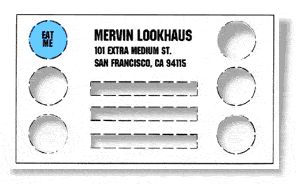
For the perforated card, each bit of identity could be punched out if inappropriate for a particular recipient. The idea could be taken one step further with some sort of punch table (like for 3-ring binders) that would, upon appropriate configuration (e.g. turn the 'When' lever to 'Friday Night' and the 'Why' lever to 'Dating'), remove all irrelevant identity. People would want to tailor their 'IdentiStampers' (Copyright Pending) to suit their tastes I'm sure.
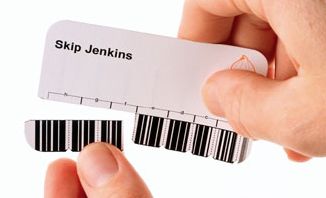
I found the description of the Onion Card particularly interesting - it paints a picture of negotiation and progressive disclosure - each participant sharing more information as their partner does. A "You show me yours and I'll show you mine" model. It also implies a connection between the physical world in which the card is presented and the digital world in which the identity is stored (and a market for compact bar code readers). I do think the cards would look much cooler if they used QR-codes.
While in the Perforated model the user holds their identity themself (under the mattress as it were); in the Onion Card model they carry only pointers to the identity, the actual data is held elsewhere on their behalf by some trusted 3rd-party and released upon successful request (with the bar codes acting as bearer tokens).
I searched for 'identity card art' (motivated by this and this) and discovered the Identity Card Concept Project an interesting exploration of possible future variations on today's business card - organized into themes of true identity , digital identity, control, memory, ritual, and branding.
Two of the control proposals, the Perforated and Onion Card feel very user-centric, the owner of a business card would be able to customize his/her card in real time to the context (who, what, where, why, when) in which it was being presented.
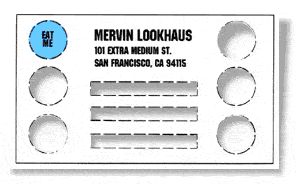
For the perforated card, each bit of identity could be punched out if inappropriate for a particular recipient. The idea could be taken one step further with some sort of punch table (like for 3-ring binders) that would, upon appropriate configuration (e.g. turn the 'When' lever to 'Friday Night' and the 'Why' lever to 'Dating'), remove all irrelevant identity. People would want to tailor their 'IdentiStampers' (Copyright Pending) to suit their tastes I'm sure.
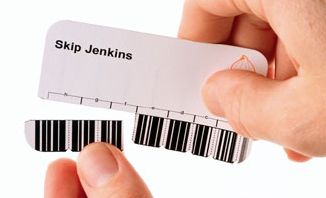
I found the description of the Onion Card particularly interesting - it paints a picture of negotiation and progressive disclosure - each participant sharing more information as their partner does. A "You show me yours and I'll show you mine" model. It also implies a connection between the physical world in which the card is presented and the digital world in which the identity is stored (and a market for compact bar code readers). I do think the cards would look much cooler if they used QR-codes.
While in the Perforated model the user holds their identity themself (under the mattress as it were); in the Onion Card model they carry only pointers to the identity, the actual data is held elsewhere on their behalf by some trusted 3rd-party and released upon successful request (with the bar codes acting as bearer tokens).
Sunday, August 20, 2006
NYC allows babies into after hours clubs

Or there could be a more mundane explanation.
Babies doing math. Wow, what a revelation. I'm guessing the researchers have never seen a baby breast-feeding.
Identity Keyboard
The Optimus Keyboard uses mini OLED displays on each key in order to dynamically customize the layout and function of a keyboard suitable to the application at hand.
Makes me think of something like the following for identity transactions, with some typical identity operations thrown in (with a little but not much thought to logical organization). The purple keys are meant to represent operations performed at the user's Identity Provider. The greeen, yellow, and red keys for responding to identity requests (with some representative answers). Other "non-identity" keys are greyed out, reproducing the visual effect of the similar Cardspace behaviour.
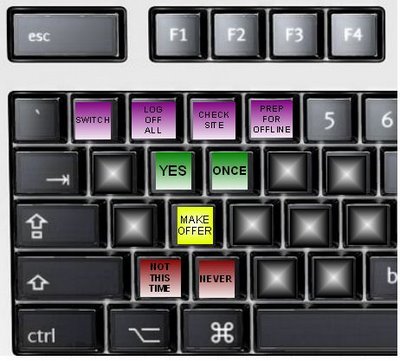
When not warranted by some request for identity, the keys would show whatever other letter/function/operation was appropriate.
Makes me think of something like the following for identity transactions, with some typical identity operations thrown in (with a little but not much thought to logical organization). The purple keys are meant to represent operations performed at the user's Identity Provider. The greeen, yellow, and red keys for responding to identity requests (with some representative answers). Other "non-identity" keys are greyed out, reproducing the visual effect of the similar Cardspace behaviour.

When not warranted by some request for identity, the keys would show whatever other letter/function/operation was appropriate.
400 years too early
When I was in Oxford last month for the XML Summer School, in between dodging gangs of colour-coordinated teenagers in the city for English instruction , I picked up a 3-pack of Antonia Fraser biographies of English notables.
I started with Cromwell, Our Chief Of Men (warts and all) and am now thoroughly enjoying King Charles II (still anticipating the debauchery - you're a King man, use the power!).
A conversation between Charles (post-Restoration) and his advisor Clarendon jumped out at me. The two are discussing (through notes passed during a Council meeting) an upcoming trip of the King:
Clarendon: I suppose you will go with a light Train
Charles: I intend to take nothing but my night bag
Clarendon: Yes, you will not go without forty or fifty horse?
Charles: I count that part of my night bag ...
There, but for the medium, is an IM log (wit and all). I'm sure Charles felt the lack of a smiley for his last :-)
Oxford was good (but not good enough) to Charles's father, as it was to me. I do hope the Royal apartments had air conditioning though.
Friday, August 18, 2006
You know you're a parent when ....

.... you're getting ready for a mountain bike ride and you can't find your water bottle and you think of an alternative.
Thank God we're past the bottle stage, who would burp me out on the trails?
So where are the scars?

Kim Cameroon responds and clarifies.
Kim had previously showed a Ping ID demo that he asserted nicely demonstrated how 'user-centric' and 'federated' were compatible but orthogonal.
I think the demo is undeniably cool and shows a perfectly valid use-case. What I question is Kim's claim that it displays some clear and fundamental distinction between user-centric and federated identity.
According to Kim, the user-centric piece of the demo (where the user authenticates to the portal with Cardspace) helps 'people get through their day' and the federated piece (in which the user is SSO'ed into various services) is 'tieing portals together'.
For the demo, this seems an accurate description. It is only when authenticating to the portal that the user appears to have any control over the release of their identity (by selecting and reviewing an Identity Card). Once signed-in to the portal, the demo suggests that the 'user-centric experience' is over, from here on the portal and the services decide what identity gets shared, and the user's ability to control this boils down to clicking on the relevant service 'Sign On' button or not. This piece of the demo doesn't appear very user-centric at all.
But of course the demo could well have shown the portal offering the user the same sort of fine-grained control over identity release to the various services - what gets shared needn't be a done deal between the portal and the services and out of the user's control.
Put another way, if user control over the sharing and use of their identity is the prime criteria for user-centricity (which I believe is the case), then there is no reason why user-centricity cannot extend into the identity exchanges between the portal and the services - the user can have meaningful control over these exchanges just as they did for the exchanges between their local IDP and the portal.
Hubert has another demo that shows "federation" technologies used in this manner.
I take the following from this thread (and another that Kim engaged in with Conor).
User-centric identity requires:
1) a philosophy of user-empowerment +
2) technology (protocols, UI, consent mechanisms, etc) in support of #1.
If an identity system has the first(who would claim anything less), but the technology can't back it up, then it's not user-centric. Conversely, technology (any) can always be applied in a non user-centric manner if not deployed in a manner consistent with the philosophy of empowerment.
The other end of the anonymity scale
Lots (here, here, here ) of blog discussion on anonymity lately.
Amazon's Real Name mechanism goes to the other extreme. In order to establish confidence (dare I say 'trust') in people's online activities at Amazon (e.g. reviews), these activities are bound to their real life identity (as verified by the credit card infrastructure). Presumably, I'm less likely to do a hack job on some book if I have my real identity attached to the review.
Interesting that such real name attribution is given less weight than reputation in determining the score for a given review.
I guess the old saying "It's not who you are but who knows you" holds true.
Amazon's Real Name mechanism goes to the other extreme. In order to establish confidence (dare I say 'trust') in people's online activities at Amazon (e.g. reviews), these activities are bound to their real life identity (as verified by the credit card infrastructure). Presumably, I'm less likely to do a hack job on some book if I have my real identity attached to the review.
Interesting that such real name attribution is given less weight than reputation in determining the score for a given review.
I guess the old saying "It's not who you are but who knows you" holds true.
Confirm your account
Don Park proposes generalizing the email mechanism (email gets sent to provided address, user clicks on embedded link) often used at registration and/or password recovery time into a true authentication mechanism.
Rather than do this only initially and then subsequently as occasionally necessary, the user would authenticate this way every time (or at least when cookie expiry made it necessary). No password necessary at the site, and so it's a kind of SSO based on the authentication to the email server. Nice.
Message delivery lags and spam filters could make the system impractical. In my experience, the 'Confirm Account' mail can arrive long after I try to register, which isn't an issue if the site lets me proceed in the interim, but would be an issue if it prevented me signing-in.
More fundamentally, it seems a step backwards. Current reality is that just about every site already has my email, and so Don's scheme wouldn't change the nature or scope of the info that I need share with sites in order to get service. But, I don't like this current reality. I don't want to have to give my email(s) out to all these sites, constantly doing the mental computation 'I'm never going to be back here so I'll use an email address with a high disposability factor'. Don's model reinforces this status quo.
As an aside, Don's model fits the pattern of challenge-response authentication - the site's challenge is 'Can you access this email account?' and the user's response is 'You bet (and proves it by clicking on the link)'. I'm surprised to see that SAML doesn't appear to provide an Authentication Context to describe this basic pattern. The only support for challenge-response in the Authentication Context schema is the SharedSecretChannelResponse element, and in Don's scheme, the email address is probably no secret.
Thursday, August 17, 2006
It's not just us
In a post from downloadsquad on a new version of the file-sharing app BearShare, comes this line
"User-centric" music sounds too much like I'd be listening to my neighbour's twangy rendition of blue grass classics. No thanks.
It sounds like iMeshToGo and BearShareToGo will offer a long awaited solution to the problem of illegal file-sharing, and the other problem of no way for people to buy music in an effective way that is user-centric.
Let's not forget the Powerpoint!
Just came across this.
It fills an important niche in the SSO space, namely the 'Monthly SSO system claiming to be simpler than SAML' niche.
The idea of sharing your Identity Provider account password with random Service Providers seems attractive. After all, if I'm presenting it to every site I interact with I'm less likely to forget it. As they say in the Guiness ads, "Brilliant!".
The following sentence particularly caught my attention.
I don't know why people are constantly scoping the Liberty Alliance down to the publication of just PDF documents - we are far more than just that. It seems that just because the best known examples of our published material are in PDF, then somehow we get typed as only publishing in PDF.
Fundamentally, the Liberty Alliance defines a marketing framework, a platform on which can be built systems capable of publishing in a variety of formats appropriate to different marketing applications. Any particular publishing run is able to use the Liberty framework in a manner that suits the sort of marketing campaign being targetted. Examples of particular file formats supported by the Liberty framework include Powerpoint, HTML, JPEG, Flash etc and of course, yes, PDF.
There are lots of publishing frameworks that support one or two of the above formats, LAP is, AFAIK, unique in its "publishing format breadth".
Update: Conor reminds me that Liberty has also published in plaintext. I also forgot WML. This just reinforces my point about the flexibility of the Liberty publishing engine.
Conor also implies that, in my eagerness to deride, I missed the point. Ah my constantly green-clad Irish friend, I knew full well that others would make the 'billion Liberty-enabled identities' & 'countless deployments' argument (as well as dig deeper than I did in an actual security & privacy assessment of the proposed SSO solution).
It fills an important niche in the SSO space, namely the 'Monthly SSO system claiming to be simpler than SAML' niche.
The idea of sharing your Identity Provider account password with random Service Providers seems attractive. After all, if I'm presenting it to every site I interact with I'm less likely to forget it. As they say in the Guiness ads, "Brilliant!".
The following sentence particularly caught my attention.
The Liberty Alliance has churned out a number of PDFs but that seems to be the extent so far of their effort.
I don't know why people are constantly scoping the Liberty Alliance down to the publication of just PDF documents - we are far more than just that. It seems that just because the best known examples of our published material are in PDF, then somehow we get typed as only publishing in PDF.
Fundamentally, the Liberty Alliance defines a marketing framework, a platform on which can be built systems capable of publishing in a variety of formats appropriate to different marketing applications. Any particular publishing run is able to use the Liberty framework in a manner that suits the sort of marketing campaign being targetted. Examples of particular file formats supported by the Liberty framework include Powerpoint, HTML, JPEG, Flash etc and of course, yes, PDF.
There are lots of publishing frameworks that support one or two of the above formats, LAP is, AFAIK, unique in its "publishing format breadth".
Update: Conor reminds me that Liberty has also published in plaintext. I also forgot WML. This just reinforces my point about the flexibility of the Liberty publishing engine.
Conor also implies that, in my eagerness to deride, I missed the point. Ah my constantly green-clad Irish friend, I knew full well that others would make the 'billion Liberty-enabled identities' & 'countless deployments' argument (as well as dig deeper than I did in an actual security & privacy assessment of the proposed SSO solution).
Wednesday, August 16, 2006
A new FOAF tool
FOAFGen.net is a FOAF generator.
Unlike other such tools, this one allows FOAF files to be created in batch mode from vCard and LDIF inputs.
Problem remains as to what to do with the thing once you've created it. And how to keep it synchronized with your contacts.
Unlike other such tools, this one allows FOAF files to be created in batch mode from vCard and LDIF inputs.
Problem remains as to what to do with the thing once you've created it. And how to keep it synchronized with your contacts.
Judging IDDY
Strictly speaking, these should be the LAPIDDY Awards - for Liberty Alliance Project Identity Deployments of the Year. Rolls off the tongue too.
I think of the stated criteria (e.g. demonstrable ROI and benefits, etc) as loose 'best-practices' for judging rather than normative MUSTs and SHOULDs.
Any deployment that uses a spec I have an emotional attachment to might just have an advantage. Show me a People Service implementation, even if only sketched out with lipstick on a cocktail napkin and coded in Fortran, and start planning what you'll wear on stage when you accept (assuming I can sway the others).
I think of the stated criteria (e.g. demonstrable ROI and benefits, etc) as loose 'best-practices' for judging rather than normative MUSTs and SHOULDs.
Any deployment that uses a spec I have an emotional attachment to might just have an advantage. Show me a People Service implementation, even if only sketched out with lipstick on a cocktail napkin and coded in Fortran, and start planning what you'll wear on stage when you accept (assuming I can sway the others).
Monday, August 14, 2006
Shouldn't there be a Web 2.0'ish app for this?
I need to track hot tub jet replacement.
I've experimented with permanent markers to identify the replaced jets - it seems 'permanent' doesn't apply to hot chemical baths. Tape gums up. I'd lose any record on my PC. Consequently ....

I've experimented with permanent markers to identify the replaced jets - it seems 'permanent' doesn't apply to hot chemical baths. Tape gums up. I'd lose any record on my PC. Consequently ....
Public Key (chains)
Just over 4 years ago, the Liberty Alliance had a meeting in Paris. My wife had given birth to our daughter Sophie just 6 days before I had to travel. While in Paris, in a mood of homesick nostalgia, I popped for an over-priced key chain (the sort of kitch that tourist shops make their margin on) as a small gift for my new girl.
I've been popping for similarly over-priced key chains for Sophie at every location I've since travelled to. Her first question when I return from a trip is inevitably 'Did you get me a key chain?' She has even created a taxonomy for the different styles, e.g. the 'turny' ones are her favourites (three of them visible at lower left below).
As Liberty Technology Expert Group is returning to Paris next month, it seems an appropriate time for a status report.
I've been popping for similarly over-priced key chains for Sophie at every location I've since travelled to. Her first question when I return from a trip is inevitably 'Did you get me a key chain?' She has even created a taxonomy for the different styles, e.g. the 'turny' ones are her favourites (three of them visible at lower left below).
As Liberty Technology Expert Group is returning to Paris next month, it seems an appropriate time for a status report.
Sunday, August 13, 2006

User-centrification
Kim Cameron has a screen cap movie of a demo created by Ping ID.
Kim asserts that the demo illustrates (paraphrasing) "user-centric technologies like Information Cards are not in any way counterposed to federation technologies".
I completely agree with the sentiment, but question whether the scenario portrayed by the demo actually demonstrates it.
In the demo, a user authenticates to a portal using CardSpace. Once authenticated, they are presented with a list of applications available to them for which SSO is possible (this presumably dependent n which I-Card they selected). For Kim, the user-centric piece (CardSpace) somehow ends at the portal, and from then on federation (SAML etc) takes over.
So, user-centric and federated technologies are shown as working together - but not at the same time. The user-centric piece hands off to the the federation piece. Federation is presented as a lower-level piece of infrastructure (which it can be) that doesn't seem to touch the user.
This interpretation is reinforced by Kim
This ignores the possibility for SAML-based technologies to provide the very same user-experience (i.e. real-time identity sharing control, IDP selection etc) that I-Cards enables. Is SAML's Enhanced Client or Proxy (ECP), as it enables similar control mechanisms, then user-centric?
Probably not, as Kim also hilites the common UI of Cardspace and its relevance
If the phone manufacturers (or those of set top boxes) were to come together and agree on user-interface standards - would that be user-centric?
Kim asserts that the demo illustrates (paraphrasing) "user-centric technologies like Information Cards are not in any way counterposed to federation technologies".
I completely agree with the sentiment, but question whether the scenario portrayed by the demo actually demonstrates it.
In the demo, a user authenticates to a portal using CardSpace. Once authenticated, they are presented with a list of applications available to them for which SSO is possible (this presumably dependent n which I-Card they selected). For Kim, the user-centric piece (CardSpace) somehow ends at the portal, and from then on federation (SAML etc) takes over.
So, user-centric and federated technologies are shown as working together - but not at the same time. The user-centric piece hands off to the the federation piece. Federation is presented as a lower-level piece of infrastructure (which it can be) that doesn't seem to touch the user.
This interpretation is reinforced by Kim
To my way of thinking, you have two more or less orthogonal technology efforts - that oriented around federation issues, and that oriented around the user’s experience.
This ignores the possibility for SAML-based technologies to provide the very same user-experience (i.e. real-time identity sharing control, IDP selection etc) that I-Cards enables. Is SAML's Enhanced Client or Proxy (ECP), as it enables similar control mechanisms, then user-centric?
Probably not, as Kim also hilites the common UI of Cardspace and its relevance
Should my experience therefore be totally discontinuous as I move from one portal to another, being organized by the portal rather than by my own system
If the phone manufacturers (or those of set top boxes) were to come together and agree on user-interface standards - would that be user-centric?
Friday, August 11, 2006
Upcoming flight restrictions a boon to online services
Robin Wilton links to some tips for business travellers dealing with the risk of checking in a laptop.
Makes the Google OS model more and more attractive. Maybe they should be marketing a $100 laptop at business travellers rather than the masses.
Makes the Google OS model more and more attractive. Maybe they should be marketing a $100 laptop at business travellers rather than the masses.
Tuesday, August 08, 2006
Girls Gone Wild - why of course it's about identity
and people watch the videos for the sparkling conversations
On the Identity Trail
If this title doesn't push my stats through the roof (i.e. 20/day) I will be very disappointed.
On the Identity Trail
If this title doesn't push my stats through the roof (i.e. 20/day) I will be very disappointed.
Sunday, August 06, 2006
Who speaks for the trees?
Kim Cameron ponders on the MySpace 'salute' mechanism for identity verification (of sorts).
In MySpace's FAQ, the answer to 'Someone is pretending to be me - what do I do?' includes:
Beyond the environmental trajedy of the trees that will be cut down to supply paper for these signs, Kim points out the difficulties with this scheme, arising I think from the fact that the MySpace staffers aren't at all qualified to say which face (unless some celebrity) goes with an identity. The people who are qualified to make this distinction are those that know the person outside of MySpace and so can say 'Uhh, Bob doesn't have red hair and breasts ...'
Maybe the mechanism should require that there be two people in the picture, one claiming 'I am Bob' and one attesting 'I am Tony and this (pointing) is indeed Bob'. But, then who attests to the attestor's identity? Ok, three people in the photo ....
I have to wonder why they stipulate that the URL on the sign be hand written. To prevent automated machine salutes?
In MySpace's FAQ, the answer to 'Someone is pretending to be me - what do I do?' includes:
In order to verify your identity, please send us a "salute". This means we will need an image of yourself holding a handwritten sign with the word "MySpace.com" and your Friend ID
Beyond the environmental trajedy of the trees that will be cut down to supply paper for these signs, Kim points out the difficulties with this scheme, arising I think from the fact that the MySpace staffers aren't at all qualified to say which face (unless some celebrity) goes with an identity. The people who are qualified to make this distinction are those that know the person outside of MySpace and so can say 'Uhh, Bob doesn't have red hair and breasts ...'
Maybe the mechanism should require that there be two people in the picture, one claiming 'I am Bob' and one attesting 'I am Tony and this (pointing) is indeed Bob'. But, then who attests to the attestor's identity? Ok, three people in the photo ....
I have to wonder why they stipulate that the URL on the sign be hand written. To prevent automated machine salutes?
Saturday, August 05, 2006
Wednesday, August 02, 2006
No fault of mine
I have to wonder at which sort of users the below fault message (from Yahoo's AJAXy mail beta) is targetted at.
 Will the fact that 'There was no XML in the response' be helpful to Roy in Saskatchewan?
'Ahh, yes, that makes sense, I thought the problem might be the XML response status ...'.
 Will the fact that 'There was no XML in the response' be helpful to Roy in Saskatchewan?
'Ahh, yes, that makes sense, I thought the problem might be the XML response status ...'.
Tuesday, July 18, 2006
Why not a gramaphone?
It is forbidden to wear head sets connected to a mobile device such as a CD player.CD player? What percentage of music liseners are playing CDs?
It's time for Air Canada to update their admonishments to reflect current technology.
Friday, July 14, 2006
Tips for Vancouver Travellers
If you are going to Vancouver next week for the Liberty Sponsors meeting or the Identity Open Space, some local knowledge.
- Sprinkle 'ehs' liberally throughout your conversation with the Canada Customs officer - as in 'Im just here for an identity conference eh. Beauty eh'. They will appreciate your effort and might even offer you a tour of the 'back rooms' that most tourists don't get to see.
- Its 'orrrrnge', not 'or ange'
- Canada isn't actually 'the cold Puerto Rico'.
- Vancouverite's (and some others) believe their city is the best place in the world to live. They will tell you this over and over. Expect to hear it from the cabbie on the ride from the airport. Expect to hear it from the homeless panhandling for money. When they do, ask them if downtown meets the technical criteria of a rainforest.
- Canada has two official languages - Eastern and Western.
- To really impress, when you want a coffee ask the Concierge where the nearest "Tim's" is. When at a Tim Horton's, don't fall for the marketing hype and order a flavoured Ice Capp - they are crap and you will regret the waste of your money.
- Some stores will take US money at par.
- Canadians apologize alot. Sorry about that.
- Unfortunately, next week's meetings happen to fall in the middle of the 10 day window in which the league takes a break so you will be unable to see any professional hockey. Even were this not the case you wouldn't be able to see any truly professional hockey in Vancouver.
- Gastown offers a complementary 'Dick Hardt Double Decker Bus Tour'. From air conditioned comfort you can see where Dick lives, his favourite coffee shops, and his Porsche dealer. I believe they even have the commentary in different lanaguges e.g. Sxip, SAML, LID etc. A must do.
Wednesday, July 12, 2006
I'm sick of my iPod playlists
I can listen to other people's playlist using Webjay, I should have the same option on my iPod.
Something like:
Something like:
- I upload my library (just the metadata) to a server
- I define criteria for a playlist, e.g. # songs, preferred theme
- Somebody mixes me a playlist using songs from #1 and meeting criteria of #2
- I download said playlist to iTunes where I give it a listen
- I bitch about said playlist and question each and every song
- I give above feedback to playlist creator for their education, their reputation is adjusted accordingly
Wednesday, July 05, 2006
Litter Kid
My 9 year old son has started a blog.
He gets some money, the neighborhood gets cleaned up a bit, and I get him out of the house for an hour.
He was very excited about his first post. Told his mother that he 'now has a blog' - she told him to clean it up.
He gets some money, the neighborhood gets cleaned up a bit, and I get him out of the house for an hour.
He was very excited about his first post. Told his mother that he 'now has a blog' - she told him to clean it up.
Peeps Service - Aldo interviews Conor
Episode 33 of the Story of Digital Identity is up.
Conor, better than anybody, can speak to the design principles and evolution of the Liberty Alliance's identity architectures. Conor's description of Alice & Bob brought back memories of many a whiteboard session.
If you listen closely, you might even hear an opinion sneak through (they'll be the sentences prefaced with 'we'.)
Jibes notwithstanding, I'd have Conor in my Peeps Service anyday (although I expect I'd be selective about who could query that fact).
Conor, better than anybody, can speak to the design principles and evolution of the Liberty Alliance's identity architectures. Conor's description of Alice & Bob brought back memories of many a whiteboard session.
If you listen closely, you might even hear an opinion sneak through (they'll be the sentences prefaced with 'we'.)
Jibes notwithstanding, I'd have Conor in my Peeps Service anyday (although I expect I'd be selective about who could query that fact).
Subscribe to:
Posts (Atom)