I was trying to explain what I do to my 6 year old son.
I presented a scenario of him playing a game at one site and then his high score being made available at some other site he travelled to.
After a pause he said 'So you help them connect?'.
'Exactly' I replied.
'But then what happens when you are sick. Do they just not connect on that day?'
Tuesday, December 13, 2005

Federated log-in & email validation
While playing around with an OpenID identity I received from Videntity, I saw an interesting artifact of the federated log-in mechanism.
At LiveJournal, I opted to sign in with my Videntity Open ID instead of using my local account. Everything worked great, I was redirected to Videntity, there I logged in, and was then redirected back to LiveJournal as my OpenID identity.
However, when I clicked on 'Manage My Account' at LiveJournal, I saw the following
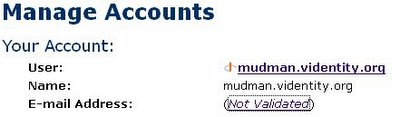
Because my account at LiveJournal was virtual, there was no email that would have been validated through the normal registration process. When I clicked on the 'Not Validated' string, I saw this
 LiveJournal didn't have an email for me so it tried to create one.
This is of course in no way specific to OpenID but just reflects how LiveJournal's account management mechanisms assumed an old-style account in which I would have supplied an email at registration.
If I had instead supplied my email to Videntity, then (assuming I authorized its release) it could have been passed to LiveJournal and there would have been a validated email for me (albeit validated by Videntity) for LiveJournal to display.
At LiveJournal, I opted to sign in with my Videntity Open ID instead of using my local account. Everything worked great, I was redirected to Videntity, there I logged in, and was then redirected back to LiveJournal as my OpenID identity.
However, when I clicked on 'Manage My Account' at LiveJournal, I saw the following
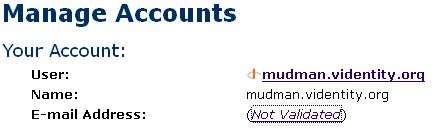
Because my account at LiveJournal was virtual, there was no email that would have been validated through the normal registration process. When I clicked on the 'Not Validated' string, I saw this
 LiveJournal didn't have an email for me so it tried to create one.
This is of course in no way specific to OpenID but just reflects how LiveJournal's account management mechanisms assumed an old-style account in which I would have supplied an email at registration.
If I had instead supplied my email to Videntity, then (assuming I authorized its release) it could have been passed to LiveJournal and there would have been a validated email for me (albeit validated by Videntity) for LiveJournal to display.
ISSO & Authentication Context
Looking at the i-names SSO (ISSO) spec being defined at XDI.org, they account for some minimum password strengths by which users MUST authenticate to their i-Broker (within the XDI.org community)
To help prevent dictionary attacks, XDI.ORG MUST specify a minimum password strength required of all ISSO accounts in the XDI.ORG network.
As they use SAML 2.0 as the protocol by which the Website requests an authentication and by which the i-Broker responds, it seems strange that they don't refer to SAML 2.0's Authentication Context as the mechanism for defining such minimum authentication requirements.
Friday, December 09, 2005
Planet Identity GreaseMonkey Script
I don't like to read my own blog entries at Planet Identity so I created the following GreaseMonkey script to remove my posts.
// ==UserScript==
// @name Ignore Planet Identity Users
// @namespace http://www.planetidentity.org
// @description deletes my blogs
// @include http://www.planetidentity.org/*
// ==/UserScript==
ignorelist = new Array("Paul Madsen", "Other author");
var allDivs, thisDiv;
allDivs = document.evaluate(
'//div[@class=\"entry\"]',
document,
null,
XPathResult.UNORDERED_NODE_SNAPSHOT_TYPE,
null);
for (var i = 0; i <>
thisDiv = allDivs.snapshotItem(i);
for(j = 0; j <>
if(thisDiv.childNodes[1].childNodes[0].innerHTML == ignorelist[j]) {
thisDiv.parentNode.removeChild(thisDiv);
}
}
}
Others could use it "out of the box" or adapt as preferred by modifying the ignore list array above.
Thursday, December 08, 2005
Screwy GUI
To access my frequent flier account online I have a 9-digit account number and a password.
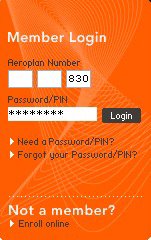
For some reason, the Aeroplan Web designers have decided to get creative with the GUI for logging in. Rather than providing a single HTML <input> element, they've divided it up into three separate input elements.
The problem is, Firefox's password manager can only recognize one of the three input fields for form fill.
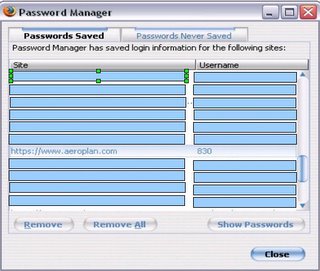 Consequently, only the last 3 get filled in automatically.
 I guess the lesson is that if a request for identity isn't properly posed then the IDP can't respond.
For some reason, the Aeroplan Web designers have decided to get creative with the GUI for logging in. Rather than providing a single HTML <input> element, they've divided it up into three separate input elements.
The problem is, Firefox's password manager can only recognize one of the three input fields for form fill.
 Consequently, only the last 3 get filled in automatically.
 I guess the lesson is that if a request for identity isn't properly posed then the IDP can't respond.
False sense of Security
I have the following strings of characters to remember in order to access my mortgage account through the Web or phone.
- card number
- Web password
- PIN
- telephone security string
- verbal passphrase
All these for a single account. Of course I write them down. I've complained to the bank that I shouldn't have to and thereby potentially compromise my account. No change. Seems that the perception of secerity is more important than the reality.
I wish I could forget the amount of debt as easily.
Imported Authn
In Collapse, Jared Diamond describes the impact of Australia's remoteness from the rest of the world:
I guess the only thing less bulky than a SAML assertion is an X.509 cert but historically these haven't travelled well - they start to rot in their containers round about the Equator.
The economics of the above only make sense for products low in bulk, high in intrinsic value, and, importantly, which can withstand the ordeals of the trip. You ship the concentrated juice and not the fruit; the bacon and not the hogs.
with modern globalization, it is cheaper to grow oranges in Brazil and ship the resulting orange juice concentrate 8,000 miles to Australia than to buy orange juice produced from Australian citrus trees. The same is true of Canadian pork and bacon compared to their Australian equivalents.
I guess the only thing less bulky than a SAML assertion is an X.509 cert but historically these haven't travelled well - they start to rot in their containers round about the Equator.
Wednesday, December 07, 2005
Implicit federation
The fact that federated identity connects together the current archipelago of user's identity islands is sometimes presented as enabling (or at least exacerbating) identity theft. The connections are seen as amplifying the consequences of any breach, e.g. a domino effect where one after another of your accounts is compromised.
But, if federated means connected, the different accounts of many users are already implicitly federated through the passwords that they reuse to access those accounts, this percentage of users reported as high as 40% (I confess I do it for "disposeable" accounts). If one account is successfully phished and the password is stolen for that account, it's a fair bet that that user's accounts at other providers will be accessible with the same password.
In addition to making strong and different passwords more useable for the end users, federated identity makes the connections between islands explicit and thereby manageable and controlled.
But, if two currently implicity federated (through shared password) accounts are explicity federated (through SAML 2.0, ID-FF, etc) and the passwords stay the same, then the risk of the implicit federation will remain. I'm sure users would love to be prompted with a request/demand to make sure that the passwords used at the two providers were different.
Tuesday, December 06, 2005
90210
After months of running in anon mode, I decided to create an account for Pandora, a streaming music service that tailors the stream based on preferred song attributes.
Problem is, you need a US zip code to create an account.
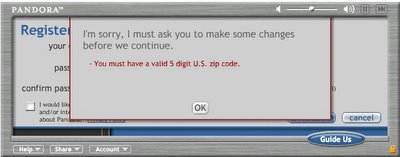
I supplied the only US zip code I knew off hand- it was accepted with no hesitation. I have to believe that there their geographic distribution of listeners would be inappropriately skewed towards Southern California.
Problem is, you need a US zip code to create an account.
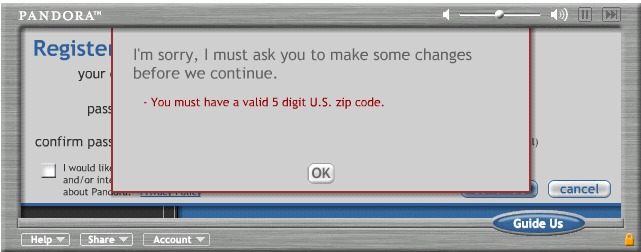
I supplied the only US zip code I knew off hand- it was accepted with no hesitation. I have to believe that there their geographic distribution of listeners would be inappropriately skewed towards Southern California.
Social Tags
One interesting (but admittedly only rudimentarily defined) aspect of Liberty's new People Service is the ability for users to tag the friends, colleagues, and family members (and any groups into which they are placed) that are members of their PS list.
Each friend or group Object can have multiple optional Tag elements, each with a ref attribute carrying a tag value (recommended to be in some established taxonomy like Flickr or Del.icio.us).
Tags are seen as an extra (to the friendly name) axis along which user's can categorize their friends and groups. As an example, if a user created two groups called 'Soccer Team' and 'Hockey Team', both groups could be tagged with 'sports' to make clear their shared relationship (as opposed to placing both in some extra hierarchal level through a 'Sports Teams' group).
Once both groups are tagged, access rights (e.g. allow any of my team-mates, irrespective of sport, to see this video) or group operations (e.g. send a party invite to all my team-mates) can be defined against the tag rather than the individual groups or individuals that have that tag.
We have much to learn here.
Geolocation with no privacy implications
Petscell is a GPS-enabled cell for pets, allowing owners to track the location of Fido.
Remote programmable geo-fence capability. Yes, I'm sure the dog will stop and come home when it gets a call.
Fortunately my children have gerbils - the phone's weight would crush them and I always know where the things are.
Remote programmable geo-fence capability. Yes, I'm sure the dog will stop and come home when it gets a call.
Fortunately my children have gerbils - the phone's weight would crush them and I always know where the things are.
Monday, December 05, 2005
Killer Identity App
Judging by the conversations I heard after the Captain turned off the seat belt sign on a trip last week to Austin, there is a killer app just waiting to be built. It needs a slick marketing name but the jist of it is 'Hey, yeah we just landed, see you in 20 minutes, bye'.
Seems that many passengers have family, friends, colleagues who wait anxiously by their phones for just such brief but meaningful status updates.
Liberty's Identity Web Service Framework (ID-WSF) has all the necessary components to support such a system:
- People Service - defines a service by which one user can track those others with which they engage in online interactions
- Geolocation Service - defines a protocol by which the geographic coordinates of a user can be queried
- Subscription & notification - mechanism by which identity info requestors can subscribe to be notified if and when certain criteria are met
So, Frequent Flier uses a People Service to track their relationship with Friend, and then defines access rules at their cell phone provider such that Friend (referenced through the People Service) can see their geolocation. When Frequent Flier surreptiously turns their cell on immediately after touch down, the previously defined notification criteria (i.e. that Frequent Flier's location be within some distance of a major airport) triggers a message to that effect being sent to Friend.
You could even track miles flown for status. Maybe then I wouldn't need to save boarding pass stubs on the chance of my miles not being credited.
Panopticon - an overlooked aspect
Stefan Brands often uses the metaphor of the pantopticon to criticise federated identity models (like one possible manifestation of the Liberty Alliance architecture) in which a user's interactions with service providers are (partially) mediated by identity providers.
Stefan and Sun's Pat Patterson had an interesting discussion on the issue a while back. I won't revisit that - it's undeniable that in the LAP model that the IDP may 'learn', the discussion is to the what (it learns) and the when (it isn't appropriate).
There is another aspect of the panopticon model that gets lost in the 'IDP surveillance' theme. Panopticon refers to a proposed model for prison architecture and process in which inmates were distributed in isolated cells about a centralized watch station. In addition to the intermittent surveillance that was enabled, the architecture ensured that inmates had no contact with each other or prison officials. The theory was that such contact would interfere with the inmates reformation.
Liberty today announced the release of another rev of its identity web services framework. This release includes support for what Liberty is calling a People Service. Bottom line, People Service is designed to allow users to manage their online relationships (e.g. friends, colleagues, and family, etc) such that the various applications that depend on a social layer (e.g. photo sharing, Find a Friend, YASN, etc) can build on a single consistent social network rather than each building their own duplicative version. A bit like a SOAP API into a FOAF repository.
The People Service is a key enabler of cross-principal web service interactions, e.g. those where the identity on whose behalf a request is sent is different than the identity that owns the identity resource in question (some site querying my wife's online calendar but indicating that the request is being sent on my behalf.) A key bit of this release of WSF is defining how the multiple identities in such a scenario are expressed in the SOAP Header.
The (admittedly limited) irony is that the ID-WSF People Service enables just the sort of interactions between individuals that the panoptical model for prison (and hospital) architecture was designed to prevent. No analogy is perfect it seems.
The PS spec is here and there is a whitepaper as well.
Stefan and Sun's Pat Patterson had an interesting discussion on the issue a while back. I won't revisit that - it's undeniable that in the LAP model that the IDP may 'learn', the discussion is to the what (it learns) and the when (it isn't appropriate).
There is another aspect of the panopticon model that gets lost in the 'IDP surveillance' theme. Panopticon refers to a proposed model for prison architecture and process in which inmates were distributed in isolated cells about a centralized watch station. In addition to the intermittent surveillance that was enabled, the architecture ensured that inmates had no contact with each other or prison officials. The theory was that such contact would interfere with the inmates reformation.
solitude is in its nature subservient to the purpose of reformation
Liberty today announced the release of another rev of its identity web services framework. This release includes support for what Liberty is calling a People Service. Bottom line, People Service is designed to allow users to manage their online relationships (e.g. friends, colleagues, and family, etc) such that the various applications that depend on a social layer (e.g. photo sharing, Find a Friend, YASN, etc) can build on a single consistent social network rather than each building their own duplicative version. A bit like a SOAP API into a FOAF repository.
The People Service is a key enabler of cross-principal web service interactions, e.g. those where the identity on whose behalf a request is sent is different than the identity that owns the identity resource in question (some site querying my wife's online calendar but indicating that the request is being sent on my behalf.) A key bit of this release of WSF is defining how the multiple identities in such a scenario are expressed in the SOAP Header.
The (admittedly limited) irony is that the ID-WSF People Service enables just the sort of interactions between individuals that the panoptical model for prison (and hospital) architecture was designed to prevent. No analogy is perfect it seems.
The PS spec is here and there is a whitepaper as well.
InteracOnline

A number of Canadian banks have created a federated payment system called InteracOnline. Consumers can pay direct from their banking account, comparable to debit cards versus credit cards at the cash.
They don't use the term but the claimed benefits for the consumer read right out of federated identity white papers:
- Privacy: you do not need to provide any financial details, card numbers or login information to the online merchant.
- Ease of use: because the payment is conducted through web banking, you don’t need to worry about creating any new passwords or accounts.
- Security: the payment is completed through the Financial Institution you know and trust.
- Spending Control: The Interac Online service helps you better manage your finances – you can’t spend more than what you have in your bank account!
Despite the currently small number, there seems quite the mix of participating merchants. Professional curiosity as to implementation, UI design etc will almost certainly require me to conduct further research at one or two of these sites (most likely chosen at random).
Thursday, November 24, 2005
Social Navigation
Supposedly, it's easier to just ask someone nearby where you are rather or how to get someplace than using mobile navigation applications - at least until the phone interfaces make this less cumbersome.
Whoever believes this has never asked a random passerby how to get to Ueno Park from Shinjuku in Tokyo. 'Sumimasen, Ueno doko desu ka?' only gets you so far.
Whoever believes this has never asked a random passerby how to get to Ueno Park from Shinjuku in Tokyo. 'Sumimasen, Ueno doko desu ka?' only gets you so far.
Wednesday, November 23, 2005
Ummmmm Bacon
Andre Durand conjectures that the network is collapsing (in the sense that nodes, be they devices or people, are more easily connected than in the past). With the help of his mathematician father, he explores the rate of collapse, e.g. from year to year how much closer are the nodes. Interesting stuff.
As a starting point, they use what they call 'Kevin Bacon's 6 Degrees Theory'. Problem is, I don't think there is such a theory - this expression conflates two different ideas of small-world research.
The first is the well-known '6 degrees of separation' theory - the idea that anyone on the Earth can be connected to any other through a chain of at most 5 acquaitances. The second aspect is a game called 'Six Degrees of Kevin Bacon' in which Hollywood actors are labelled by their 'distance' from Kevin Bacon, this determined by how many links there are in the chain of co-actors between them and Bacon. So, different actors are said to have different 'Bacon numbers' (just as mathematicians can be labelled by their Erdos number)
But, as far as I know, there has never been a conjecture that the number 6 is in any way special for the Bacon number. A variety of actors will have this for a Bacon number, but many others will have Bacon numbers of 5 and 7.
It's meaningful to explore either the possibility that '6 degrees of separation' is becoming '5 degress of separation' (likely but by no means certain) or the possibility that a given actor's Bacon number decreases over time (it can't get larger) - but seems to me that Andre and his father are trying to combine the two.
Maybe we should define a Cameron Number, e.g. how distant people are from Microsoft's Kim Cameron - this distance defined with respect to blog roll membership (among other possible criteria like shared conference attendance). I don't personally know Kim but nonetheless have a Cameron Number of '2' (thank you Pat Patterson).
Tuesday, November 22, 2005
QR codes for two-factor authentication
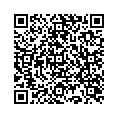
On a recent trip to Tokyo, I was able to see some of the work of my colleagues at the Tokyo NTT Information Platform Sharing Laboratories exploring the potential of two-channel authentication systems. Such systems generally depend on various permutations of secrets shared across both a PC channel and a separate device channel. In essence, the phone serves as a second authentication factor.
Existing two-channel systems rely on either:
1) the client providing a phone number at registration time to which the service provider sends a OTP over SMS when the user logs in. When received by the user on their phone, they then enter it on the PC interface. By verifying the presented OTP, the server can be confident that the user is indeed the owner of the phone and therefore the account holder.
2) the server creating a one time phone number and presenting it to the user through the PC-channel. The user then calls this number from a phone with a previously registered number. The server, by verifying that the call came from a registered number, can be confident that the user is the account holder.
Both systems require that the user's phone number be provided to the server, which presents both privacy and scaleability (the server has to store these numbers) issues. The first relies on the security of SMS.
My colleagues are working on alternatives that:
a) don't rely on a phone number being registered/stored
b) leverage the certificates on many Japanese phones for client-auth SSL
c) authenticate the server as well
In both models above, it is the user that acts as the conduit by which the PC and phone channels are connected (this necessary for them to be correlated and authenticated). In the first, the user takes the OTP from the phone and types it into some HTML form; in the second, the user takes the presented phone number and manually dials it.
The research is exploring the potential for a technology mostly unique to the Japanese market to provide this connection/interface between the two channels. QR codes are two-dimensional bar codes into which can be embedded significantly more information. Critically, over 77% of Japanese phones have support for QR code readers. The phones' cameras can thereby serve as the conduit through which the two channels can be connected and correlated.
The prototype system has the server generate a dynamic QR code and present it to the user when authentication is required. The user uses their phone to take a picture of the code from their PC screen - the phone QR software then extracts the corresponding server address to which a mutual SSL session is established. To authenticate the server, the user sends a short text string from their PC as a nonce that the server signs and presents to the phone.
Below are pictures of 1) a user taking a picture of an on-screen QR code with their phone and 2) the phone display by which the server is authenticated.


The system is attractive because it leverages a (ubiquitous) second factor that users already have and expect to use, requires no specialized client software, does away with the privacy/scaling issue of stored phone numbers, and doesn't rely on the questionable security of SMS.
As Bruce Schneier points out, such systems can't guard against MITM attacks:
An attacker using a man-in-the-middle attack is happy to have the user deal with the SMS portion of the log-in, since he can't do it himself.
Nevertheless, to say that a technology doesn't prevent one attack doesn't mean they provide no value in defending against others.
Monday, November 21, 2005
Separation of Powers
Separation of powers is the concept within democratic government in which powers are distributed amongst different government organs to prevent any one of them from abusing that power. Along with checks-and-balances (the ability and responsibility of each to monitor the activities of the others), separation of powers is intended to reduce opportunities for tyranny.
Federated identity is sometimes criticized for exacerbating the risk of identity theft through its connection of currently separate identity collections into a greater virtual whole. The argument goes something like:
'So, if I login to the identity provider, I can then access my resources at some other service provider? That sounds nice but what happens if my identity at the identity provider is stolen/phished/pharmed/hacked, can't the thief, because of the connection, immediately jump to the service provider and steal my identity there?'
The argument is based on the assumption that some rogue individual, on hacking the identity provider, can get everything they need in order to impersonate me so that they can access my multiple federated service provider accounts.
Here is the rub though. It does the hacker no good to impersonate me, they have to impersonate the identity provider. As they do not know my various service provider credentials, they have to convince the service provider that they are the identity provider asserting to my authentication status. And, the burden of authenticating one site to another site (not to a user as in phishing) is considerably more challenging for a hacker.
If a hacker is to fool a service provider into accepting a counterfeit assertion for me (and thereby assume my identity at that service provider) it needs to present two things:
1) whatever federated identifier had previously been agreed upon between the service provider and the identity provider for myself. Present a random string and the service provider will refuse access because it won't recognize it as one of its federated users. Even if the hacker were to by chance get lucky and pick a valid identifier, its only valid when presented by the corresponding identity provider. see 2) below
2) a signature over the message carrying the above identifier associated with a key trusted by that service provider. Not any key issued by Verisign will do, the service provider will certainly keep a list of 'trusted IDPs' and if the associated key is not on the list then you are not invited to the party.
If the identity provider does things "right", then it will ensure that it is very difficult for any one entity (internal or external) to steal both of the above (it will almost certainly make it difficult to steal either as well). A "good" identity provider will implement "separation of powers" to ensure that, were one of the above was stolen, the other wouldn't be.
You can fool such an IDP once, but likely not twice.
"There's an old saying in Tennessee — I know it's in Texas, probably in Tennessee — that says, fool me once, shame on — shame on you. Fool me — you can't get fooled again." —President George W. Bush, Nashville, Tenn., Sept. 17, 2002
It's a Mad Mad World
In the Cold War, Washington advertised one policy for the use of its nuclear weapons while privately holding a very different strategy.
The visible & public policy was referred to as Assured Destruction (the 'mutual' was later added by a critic to create a more derisive acronym). AD was the idea that the only sane application of nuclear weapons was a non-application - if both sides were completely confident that they would be destoyed in any altercation they would be unwilling to strike first, and so nuclear weapons would never be used. The opposing counterforce strategy (which Qwynne Dwyer in his book War claims Washington actually held even whilst professing AD) saw such weapons providing value above and beyond their deterrent effect through their potential delivery in a controlled and constrained manner in a conventional war .
So, the "real" policy was much less restrictive in its criteria governing the 'release' of the ICBMs. While AD was based on the premise that one side's missiles would only be lanuched in retaliation to a first strike from the other side (stringent criteria) - the counterforce policy asserted that weapons could be deployed in a range of situations, e.g. in a tactical manner even as part of a convential non-nuclear altercation (relaxed criteria).
(This is the exact opposite of what I might have expected, e.g. a public bluff of aggressiveness but a more realistic and sane private plan. Of course, there were vested interests involved for which the status quo of maintaining weapon expenditure was desirable)
I wonder if the idea of different public/private policies is relevant for any policy governing release of identity information? Would a provider claim to be governed by one policy whilst actually listening to another?
If the visible policy were less stringent than the actual, the provider would receive attribute requests that would be immediately rejected - requests that would not have been sent if the advertised policy were accurate. Beyond the inefficiency, this is a privacy leak as the provider would unnecessarily learn at which requestor sites the principal had been visiting. If the advertised policy were more stringent, then the requestor might not even send requests that would be approved had they been - doesn't seem much risk (or sense) in this.
Friday, November 18, 2005
Bidirectional PII leakage
Motivated by a spate of fiascos and consequent legislation, enterprises are currently focussed on ensuring that any privacy sensitive data they may hold about individuals doesn't leak out.
Given the risks of damage to reputation and liability associated with storage of such data, how long is it before enterprises worry just as much about not allowing PII to leak in?
Ben Laurie suggests that one tenet of privacy-respecting identity management is minimalism, i.e. that only that identity information required for a particular application be shared and no more. He describes it as a principal for the protection of the individual - which it is of course.
But, it's also protection for the data requestor/recipient. Unless it has an immediate and (business)justifiable need for some piece if identity information, why ask for it, or even accept it if not requested but nonetheless offered? Or store it past any usage? Better let some identity provider, presumably with a business model and corresponding security technology and processes take the burden and risk.
Just remember to log that you didn't accept it.
Subscribe to:
Posts (Atom)