The Inquirer reports on the explosion of a laptop at a 'Japanese conference'.
My source informs me that it was the recent OMA conference in Osaka, it was a meeting on push-to-talk over cellular, and that nobody was hurt.
Rumour has it that the unlucky attendee was using an pre-beta identity selector to share their sushi preferences with a local restaurant.
Sunday, June 25, 2006

Friday, June 23, 2006
Personal QR Codes
 This blog URL converted into a QR code.
Of course, the conversion tool could be saying anything they want about me. I don't have a phone capable of reading it.
Maybe I could listen to it instead.
Thursday, June 22, 2006
Tuesday, June 20, 2006
Cardspace & the local IDP
I've read a number of times (but can't find references) that Microsoft doesn't see the locally hosted IDP as the primary one, but that rather they still expect most identity to come from trusted 3rd party IDPs. I've seen the local IDP described as 'for testing' or 'to get things rolling' etc. Makes sense, self-asserted identity has its limitations.
But, now I see Kim Cameron reference a Mike Beach post (or comment?) with the following
My interpretation of Mike's description above is that some TTP asserts (and thereby provide the authoritative identity) but the claim then gets cached by Cardspace for later presentation to a RP (the 'give it to the user for safe keeping'). This scenario would appear to be neither the (what I assume to be the default) flow of identity assertion created (at run time) and sent by the trusted 3rd party IDP to Cardspace for forwarding onto the RP, nor a self-assertion created by the local IDP.
Just when I thought I was understanding .....
But, now I see Kim Cameron reference a Mike Beach post (or comment?) with the following
This doesn't jibe with what I know (or misunderstand) of Cardspace.
In the privacy space a colleague of my shared an interesting perspective. Most corporations, especially in the B2C space, have considered user/customer identity data to be an asset. Knowledge about their users that could be leveraged for any number of marketing opportunities. With the rising concerns and increasing regulations around privacy this perspective is, or should be, starting to change. This “asset” is now becoming a liability. Data about people (corporate people and consumer people) is always going to be required to do business, but how do we get that while at the same time minimizing liability? Enter the Infocard concept. It would seem we now have a means to establish authoritative data about the user, but give it to the user for safe keeping.(emphasis mine)
My interpretation of Mike's description above is that some TTP asserts (and thereby provide the authoritative identity) but the claim then gets cached by Cardspace for later presentation to a RP (the 'give it to the user for safe keeping'). This scenario would appear to be neither the (what I assume to be the default) flow of identity assertion created (at run time) and sent by the trusted 3rd party IDP to Cardspace for forwarding onto the RP, nor a self-assertion created by the local IDP.
Just when I thought I was understanding .....
The Power of Context
Somebody named 'Pamela' left an insightful comment (in addition to that of Gerald) to a previous post of mine on the workings of Microsoft Cardspace.
Without the obvious experience and insight into Cardspace demonstrated by the commenter, I wouldn't have thought to search by combining her name and the qualifier 'identity'.
It's still only a guess but I'm pretty optimistic that the third hit down is the right one.
Adding a Canadian like Pam to Whodentity would skew the North American identity distribution just that little bit more towards the 49th (as was pointed out to me by Dave in a comment to a different post).
Without the obvious experience and insight into Cardspace demonstrated by the commenter, I wouldn't have thought to search by combining her name and the qualifier 'identity'.
It's still only a guess but I'm pretty optimistic that the third hit down is the right one.
Adding a Canadian like Pam to Whodentity would skew the North American identity distribution just that little bit more towards the 49th (as was pointed out to me by Dave in a comment to a different post).
Ownership claim mechanisms
A post on the Identity Trail, and my recent experiments with ClaimID's verification mechanism made me think about the general question of "How do I convince somebody that some online resource is mine"?
Related but different, which of the above mechanisms would serve to convince that an identity resource is 'about' me? The second, third and last options would appear to be excluded.
- By having the resource in my 'possession' (and the RP having some expectation that such possession is restricted)
- By making a modification (at the behest of the RP) to the resource
- By demonstrating my ability to control access to the resource
- By demonstrating knowledge of some secret associated with the resource
- By having a trusted 3rd party (or lots of somewhat trusted 3rd parties?) assert to my ownership of the resource
- By responding to a challenge message sent to the address of the resource
Related but different, which of the above mechanisms would serve to convince that an identity resource is 'about' me? The second, third and last options would appear to be excluded.
Dial 'N' for NoSig
 Jeff Hodges & Scott Cantor have created a proposal for a new SAML Binding - most notable for its optional use of XML Signature.
Jeff's description for the SSTC was
The central thesis is that for various implementation and deployment scenarios, reliance upon XMLdsig is an inhibitor.I think of this binding as the SAML community turning down the security dials on the protocols (or more accurately ensuring that they can be turned down in an interoperable manner) - lower settings appropriate in some situations.
I don't know just how much effort was expanded by Scott & Jeff on this work - I do know that far more would have been required to be "adding" security at this point.
As is true for haircuts - you get into trouble if you take too much off the first time.
UPDATE - Pete Rowley reminds me that hair grows back. Pete, you obviously have a fine head of hair - I myself am working through what my wife refers to as a 'Kramer period'. Nevertheless, I think we should remain sensitive to the security entitlements of those less fortunate than ourselves.
And with respect to my hairdressing ambitions, I worked through those in my university days cutting my own hair in the mirror to save beer money. As for identity, sometimes its better to delegate to a professional.
Monday, June 19, 2006
A protocol for the people
 Pete Rowley presents a nice pithy descriptor for user-centric identity - based on the idea that the prime (sole?) criteria for an identity flow to warrant the term is that it occur 'through' the user - and so Pete suggests 'people in the protocol'.
Works for me. This is consistent with a taxonomy that some Liberty folks have been bandying about - as shown in the diagram.
The idea is that such user-mediated flows are a subset of a broader category in which the user will still have the ability to specify policy and preferences for how their identity is shared, but would not directly mediate any such sharing. Identity would flow by some other route than through the user, but still determined (at least partially) by the user's own policies. In the diagram, these deployments are labelled as "user-controlled" to capture this different level of control compared to the user-centric case.
Such user-controlled scenarios are themselves a subset of more general user-consented scenarios in which the user may not be given the option for specifying their own policies for how their identity is shared - enterprise use cases being an example. Although the user may not be in control, the assumption is that they have still been given the opportunity to give their consent, even if only through their signature on their employment contract.
Additionally:
- User-centric (as typified by the channel by which identity flows) enables but does not guarantee that the user have the final say on the sharing of their identity. I'm sure that enterprise deployments of Cardspace will support administrative policy that will override any preferences the employee user might have over what cards get presented to which RPs.
- Some identity architectures support only the user-centric flows, and do not allow for the user-controlled flows. But many important identity use cases have one of both subjects offline and thereby unavailable to act as a conduit for the flow of their identity. Does the world stop when I'm not sitting in front of a browser?
- User-centric flows are often described as decoupling the RP and the IDP, and thereby supporting cases where neither need 'know' the other beforehand - this leading to 'scale'. While true in principle, in practice there are lots of other factors pushing the two providers towards each other (such as the realities of risk management) that are independent of the specific channel by which the identity flows. So, if the nature of the shared identity or the value of the transaction doesn't require/imply that the two providers 'know' each other, then it can make sense to share identity through a provider-obfuscating user-centric flow. If not, then the value of the user-mediation is diminished.
Any club that would have me ...
Would you link to a list of purported notables that excluded you? Me neither.
Notwithstanding the few exceptions, the geographic weighting of the list makes me hope that the rest of the world will be happy with the identity systems the States provide us.
Separately, it would be interesting to see the relationships (e.g. corporate partnerships, shared specification development, farm equipment riding, etc) that exist between the list members captured and then visualized.
What topoology does identerati space have? To what extent do these relationships (postive and/or negative) impact identity progress?
Notwithstanding the few exceptions, the geographic weighting of the list makes me hope that the rest of the world will be happy with the identity systems the States provide us.
Separately, it would be interesting to see the relationships (e.g. corporate partnerships, shared specification development, farm equipment riding, etc) that exist between the list members captured and then visualized.
What topoology does identerati space have? To what extent do these relationships (postive and/or negative) impact identity progress?
Friday, June 16, 2006
Top 10 quotes about authority
10) "Authority without wisdom is like a heavy ax without an edge, fitter to bruise than polish" - Anne Bradstreet
9) "Authority is quite degarding" - Oscar Wilde
8) "“There will never be a really free and enlightened State until the State comes to recognize the individual as a higher and independent power, from which all its own power and authority are derived, and treats him accordingly”" - Henry David Thoreau
7) "The ultimate authority must always rest with the individual's own reason and critical analysis." - Dalai Lama
6) "We know, on the authority of Moses, that longer than six thousand years the world did not exist" - Martin Luther
5) "When you make your peace with authority, you become authority." - Jim Morrison
4) "Anyone who conducts an argument by appealing to authority is not using his intelligence; he is just using his memory" - Leonardo Da Vinci
3) "No statement should be believed because it is made by an authority" - Robert Heinlein
2) "All authority belongs to the people" - Thomas Jefferson
and the #1 quote about authority is ...
1) "“To punish me for my contempt for authority, fate made me an authority myself.”" - Albert Einstein
9) "Authority is quite degarding" - Oscar Wilde
8) "“There will never be a really free and enlightened State until the State comes to recognize the individual as a higher and independent power, from which all its own power and authority are derived, and treats him accordingly”" - Henry David Thoreau
7) "The ultimate authority must always rest with the individual's own reason and critical analysis." - Dalai Lama
6) "We know, on the authority of Moses, that longer than six thousand years the world did not exist" - Martin Luther
5) "When you make your peace with authority, you become authority." - Jim Morrison
4) "Anyone who conducts an argument by appealing to authority is not using his intelligence; he is just using his memory" - Leonardo Da Vinci
3) "No statement should be believed because it is made by an authority" - Robert Heinlein
2) "All authority belongs to the people" - Thomas Jefferson
and the #1 quote about authority is ...
1) "“To punish me for my contempt for authority, fate made me an authority myself.”" - Albert Einstein
What's the identity analogy?
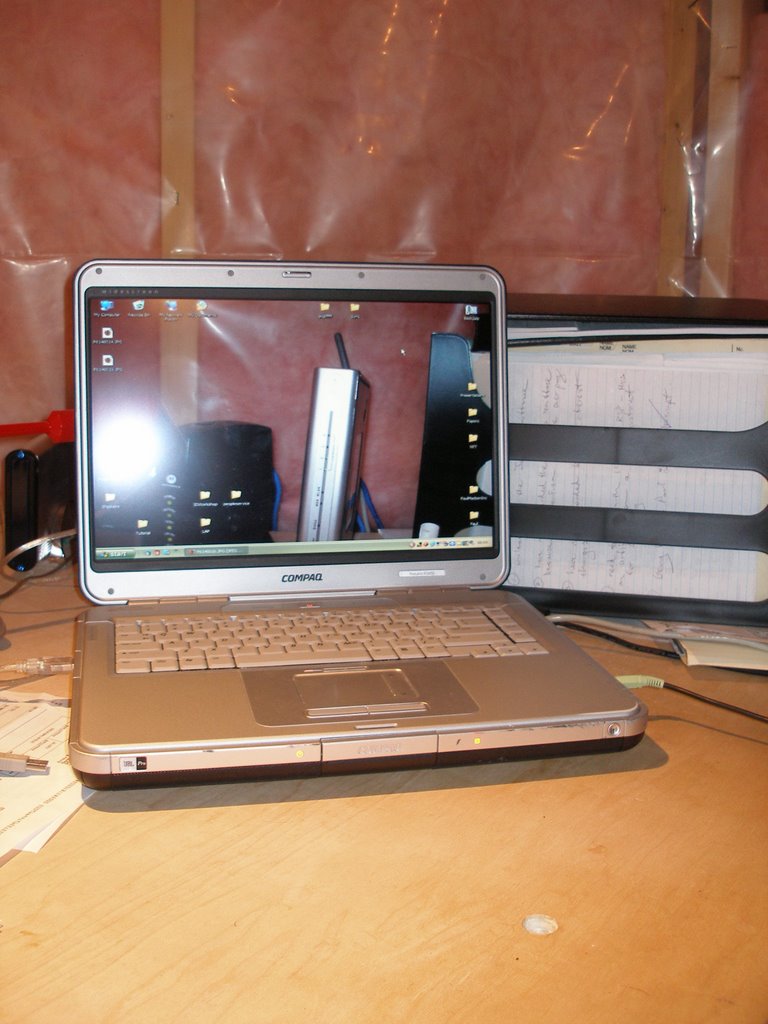
The pic is my (poor) attempt at PC trompe l'oeil.
Far better examples of the art can be found here.
There must be an analogy for identity.
A fake persona presented as real?
Or a real persona presented as fake?
Or a real persona presented as a fake persona purporting to be real?
Thursday, June 15, 2006
Sun vows they will not use SAML!
Well at least that was my first thought when I read Eve's news of Sun's "non-assertion covenant".
The truth is better.
I wish I had some IP in SAML so I could join the party.
The truth is better.
I wish I had some IP in SAML so I could join the party.
Tuesday, June 13, 2006
XHTML as a schema language?
Microformats is the philosophy of leveraging existing XHTML structures for markup, rather than defining completely new XML grammars.
As an example, the XML Friends Network (XFN) microformat builds on the XHTML <a> element and uses the "rel" attribute to express the nature of the relationship represented by the HTML link.
There definitely is something to be said for microformats as an end-of-line presentation format - everybody already has a viewer.
But, using XHTML Definition Lists (<DL> elements) to express constraints on the allowed values for the rel attribute (as is proposed here and explained here) seems a perversion.
As an example, the XML Friends Network (XFN) microformat builds on the XHTML <a> element and uses the "rel" attribute to express the nature of the relationship represented by the HTML link.
There definitely is something to be said for microformats as an end-of-line presentation format - everybody already has a viewer.
But, using XHTML Definition Lists (<DL> elements) to express constraints on the allowed values for the rel attribute (as is proposed here and explained here) seems a perversion.
Google Browser Sync
I'm liking the Google Browser Sync extension for Firefox.
Its doing a nice job of keeping my bookmarks (but not other browser settings) synchronized across two laptops. I had previously been experimenting with Foldershare for syncing the "bookmarks.html" file.
I can see this model of server-mediated sycnchronization being useful for some sorts of identity info. Everytime I start up the browser, it would go out to the IDP server, retrieve updated identity and then cache it for (possible) later use at SPs.
If not ruled out by the nature of the identity, or the need for authoritative data, the IDP wouldn't necessarily know if and when the browser subsequently presented the identity to SPs.
As clients get smarter, devices and 3rd party identity provider can work together on the user's behalf in these sorts of interactions. Grossly oversimplifying, its enabling this style of coperation that is the focus of the next phase of Liberty's architecture.
Its doing a nice job of keeping my bookmarks (but not other browser settings) synchronized across two laptops. I had previously been experimenting with Foldershare for syncing the "bookmarks.html" file.
I can see this model of server-mediated sycnchronization being useful for some sorts of identity info. Everytime I start up the browser, it would go out to the IDP server, retrieve updated identity and then cache it for (possible) later use at SPs.
If not ruled out by the nature of the identity, or the need for authoritative data, the IDP wouldn't necessarily know if and when the browser subsequently presented the identity to SPs.
As clients get smarter, devices and 3rd party identity provider can work together on the user's behalf in these sorts of interactions. Grossly oversimplifying, its enabling this style of coperation that is the focus of the next phase of Liberty's architecture.
Infocard to Cardspace
With the name change, what happens to all the blog posts tagged with the old name?
Technorati gives 190 hits for 'cardspace' ; over 2900 for 'infocard'.
Are there no 'bridging mechanisms' to prevent bloggers from having to retroactively change the occurences of the old tags in every impacted post?
Perhaps there is a market for a hosted STS (Switch Tag Service) to enable interoperability.
Technorati gives 190 hits for 'cardspace' ; over 2900 for 'infocard'.
Are there no 'bridging mechanisms' to prevent bloggers from having to retroactively change the occurences of the old tags in every impacted post?
Perhaps there is a market for a hosted STS (Switch Tag Service) to enable interoperability.
Monday, June 12, 2006
DIY-centric geolocation
Real time world cup hilites
My colleague Yuzo Koga is currently flying over the Pacific on his way to Catalyst to give a demonstration of Liberty's People Service.
Between this site and my IM alerts he is able to track the status of the Japan-Australia World Cup match from seat 19D.
Japan leads 1-0 at half time.
Between this site and my IM alerts he is able to track the status of the Japan-Australia World Cup match from seat 19D.
Japan leads 1-0 at half time.
What's the big deal?
There are lots of ring tunes that only adults would be able to hear (e.g. 'Your room is a pigsty - get up there and clean it' or 'Didn't I tell you not to pick that?') so I don't see what the fuss is about.
Sunday, June 11, 2006
Gambare Nippon!
 I expect the Canadian team was excluded on some technicality (i.e. games won etc).
 Regardless I have a worthy replacement team to cheer for.
ClaimID Claims
I've been playing around with ClaimID for a bit. I've found a few references to myself around the Web, and 'claimed' them (and verified those that I can) into my ClaimID collection.
Given stories like this, something like ClaimID seems relevant (in the absence of digital discretion).
ClaimID describes itself:
I can see how it would work if I was able to guide people. I could add my ClaimID URL to my business card or email signature and it would be the starting point from which interested parties would explore.
But this isn't the search scenario that they describe. It's not clear to me how you add this identity contextual layer to the search engines without their buy in. For ClaimID to be valuable, I need to ensure that searchers see my ClaimID explanation of that (shall we say experimental) picture of me at Burning Man before the picture itself - what good is metadata if it can't be found, displayed, integrated etc. At least currently, when I search for myself, I don't see my ClaimID page.
Does ClaimID buy a sponsored link? Or would each link have a ClaimID icon inserted beside it. Sounds like a cool application of a GreaseMonkey script (except you'd have to stipulate on your resume/business card 'Before searching for me please install this script into your browser'.)
Or do you rely on the search indexing algorythms? If I add the ClaimID URL to every page I can touch, will that ensure it rises in the hit ranks?
By the by, the description of MicroID (the mechanism by which I can verify ownership of a link) seems a stretch
Given stories like this, something like ClaimID seems relevant (in the absence of digital discretion).
ClaimID describes itself:
I see ClaimID as allowing me to add a layer of metadata about (or to) existing Web references to myself, and thereby ensure that they won't be missed (the good ones) or misinterpreted (the bad ones) by anyone who happened to be searching for me.
ClaimID is a service that lets you claim the information that is about you online. That information is then associated with your name, providing folks an easy way to see what is and isn't about you online. In doing so, you get to influence the search engines, and provide people more relevant information when they search for you. It's time to reclaim some power back from the search engines. ClaimID is about letting you have some say in what search engines say about you.
I can see how it would work if I was able to guide people. I could add my ClaimID URL to my business card or email signature and it would be the starting point from which interested parties would explore.
But this isn't the search scenario that they describe. It's not clear to me how you add this identity contextual layer to the search engines without their buy in. For ClaimID to be valuable, I need to ensure that searchers see my ClaimID explanation of that (shall we say experimental) picture of me at Burning Man before the picture itself - what good is metadata if it can't be found, displayed, integrated etc. At least currently, when I search for myself, I don't see my ClaimID page.
Does ClaimID buy a sponsored link? Or would each link have a ClaimID icon inserted beside it. Sounds like a cool application of a GreaseMonkey script (except you'd have to stipulate on your resume/business card 'Before searching for me please install this script into your browser'.)
Or do you rely on the search indexing algorythms? If I add the ClaimID URL to every page I can touch, will that ensure it rises in the hit ranks?
By the by, the description of MicroID (the mechanism by which I can verify ownership of a link) seems a stretch
A MicroID is a standards-based way to "claim" a page that you have authored.
Friday, June 09, 2006
Sub-urban Legend?
Identity Woman is up in arms about the possibility of her cell number being released to marketers.
I would be as well ... if it were true.
A quick google of the purported 'do not call' number of '888-382-1222' found this.
I would be as well ... if it were true.
A quick google of the purported 'do not call' number of '888-382-1222' found this.
Those damn Danes!
Can't fight the numbers
Nokia commisioned a survey on how people use their cells now, and how they want to use them in the future. The results are interesting
- 44% use their mobile device as their primary camera, with India being home to the most prolific mobile photographers (68%).
- Globally, seventy two percent now don't use a separate alarm clock and 73% use their mobile as their main watch or clock.
- 36% of respondents are browsing on their mobile devices at least once a month. Japan leads the way in mobile internet usage with 37% admitting to going online on their mobile on a daily basis.
- 94% of those questioned plan to have a mobile in the future. People in Brazil love mobiles so much that 100% believe they'll own a mobile device in years to come.
- 21% would be more upset about losing their mobile than their wallet, credit cards and even their wedding ring.
- 67% predict the mobile phone will replace their MP3 player.
- 42% of respondents globally want their printer, PC, stereo, TV and mobile device interconnected.
- 58% of those questioned would like to be able to control all their household appliances via their mobile device.
MyStalk
DatingAnyone allows people to track the dating status (e.g. single, swinger, in a relationship) of particular MySpace members, and be notified if and when it changes.
Their bot trawls only publicly available information, the same as would be available by browsing the MySpace Web interface. The MySpace profile also includes smoking & drinking habits - how long before the respective lobbying organizations for these two industries start to harvest and leverage the availability of this info - the demographics are right.
Their bot trawls only publicly available information, the same as would be available by browsing the MySpace Web interface. The MySpace profile also includes smoking & drinking habits - how long before the respective lobbying organizations for these two industries start to harvest and leverage the availability of this info - the demographics are right.
Google - buying my identity one piece at a time
 What used to be a single bookmark to my Google home page on my Firefox Bookmarks Toolbar Folder has now become a folder.
A sea of acronyms
Darryl sent along the following list of acronyms (some freshly minted) that we used in a recent Liberty meeting:
WSC, TM, TMA, WSP, DS, IdP, IETF, HTTP, REL, SP, SAML, MED, MING, AOL, PIS, PISID, SSO, MRD, PSTN, IS, SSL, SSN, CDR, Radius, XCap, iClient, TMM, URI, DAA, DMS, IABT, PPCSU, MCSU, MCPCSU, MBT, LUAD, BMEG, WTF, WSF, AS, SASL, SSTC, MINGED, PAOS, AIM.
I was there and have no idea of what some of these represent.
I do remember 'WTF' was particularly popular as we reviewed a requirements document.
WSC, TM, TMA, WSP, DS, IdP, IETF, HTTP, REL, SP, SAML, MED, MING, AOL, PIS, PISID, SSO, MRD, PSTN, IS, SSL, SSN, CDR, Radius, XCap, iClient, TMM, URI, DAA, DMS, IABT, PPCSU, MCSU, MCPCSU, MBT, LUAD, BMEG, WTF, WSF, AS, SASL, SSTC, MINGED, PAOS, AIM.
I was there and have no idea of what some of these represent.
I do remember 'WTF' was particularly popular as we reviewed a requirements document.
Anonymous air travel
On a dare, Jim Harper makes it through security at SFO without presenting any identification.
Notwithstanding the signs asserting that identification MUST be shown for flying in the US, it seems that the real policy is a MAY - either show some approved id or submit to more extensive searches. So, prove your verinymous identity, or stay anonymous but otherwise demonstrate you pose no risk.
I guess the computing parallel would be to be granted root privileges after proving you have no programming ability. I'm in.
Notwithstanding the signs asserting that identification MUST be shown for flying in the US, it seems that the real policy is a MAY - either show some approved id or submit to more extensive searches. So, prove your verinymous identity, or stay anonymous but otherwise demonstrate you pose no risk.
I guess the computing parallel would be to be granted root privileges after proving you have no programming ability. I'm in.
Wednesday, June 07, 2006
Tenuous Connection to Identity
Seed magazine reports that researchers have discovered a connection between genetics and human sexual behaviour. Shocking news!
Given that our sexual behaviour is the mechanism (though not the only possible one) by which our genes reproduce themselves - it would be very surprising were sexual behaviour (like many others aspects of our social interactions) not genetically linked to some extent.
Does beg the question, how can a genotype that leads to a low sex-drive phenotype persist and not be selected out? All else being equal, somebody with a low sex-drive will be less likely to have descendants than somebody else with normal or high levels of 'horniness'. Fewer descendants means that fewer copies of the gene will survive. I expect that the horniness gene is somehow linked to another whose advantages can outweigh this effect.
As justification for a post on genetics & sexuality here, I point to a currently (long) running thread on the ID Gang list on the applicability and issues of DNA as a biometric.
Given that our sexual behaviour is the mechanism (though not the only possible one) by which our genes reproduce themselves - it would be very surprising were sexual behaviour (like many others aspects of our social interactions) not genetically linked to some extent.
Does beg the question, how can a genotype that leads to a low sex-drive phenotype persist and not be selected out? All else being equal, somebody with a low sex-drive will be less likely to have descendants than somebody else with normal or high levels of 'horniness'. Fewer descendants means that fewer copies of the gene will survive. I expect that the horniness gene is somehow linked to another whose advantages can outweigh this effect.
As justification for a post on genetics & sexuality here, I point to a currently (long) running thread on the ID Gang list on the applicability and issues of DNA as a biometric.
Tuesday, June 06, 2006
Top-down eh!

I'm reading Pierre Burton's The Last Spike - his history of the building of the Canadian Pacific Railway.
The construction camps for the road were 'dry'. In a chapter on the effect of prohibition on the construction of the railway, Burton writes:
Lively they were, and never entirely dry, but the prairie railway camps, in contrast to those south of the border, were relatively tame. The contractors, American and Canadian, were grateful. "When a man breaks the law here", one American boss told George Grant, "justice is dealt to him a heap quicker and in larger chunks than he has been accustomed to in the States. I tell you there is a way to do it, and they are doing it here, right from scratch". What he was praising, of course, was the Canadian passion for order imposed from above - a British colonial heritage - as against the American concept of localized grass-roots democracy. There were no gun-toting town marshalls keeping the peace in the Canadian West; instead there was a federally appointed, quasi-military constabulary. The Mounties did not have to stand for election, they were relatively incorruptible, and they were fair; that was one of the reasons why the Canadian West lacked some of the so-called colour of its American counterpart.
I'm just glad Liberty receptions aren't dry. Train engines need to be kept lubricated.
p.s. Extra credit exercise - write a 5-page essay on "Railway gauges and their competitive application". Avoid the use of 'de facto' for bonus marks.
Monday, June 05, 2006
No animals were harmed in the manufacture of this token
 Cleaning up a neighborhood road with family & friends, we took out 22 bags of garbage. We also took out a single RSA SecurID token previously belonging to an employee of a prominent local IT company (likely stolen and then tossed into the woods once the thief realized it wasn't a garage door opener).
The token has an URL on its back, at which there are instructions for anybody who comes across a token.
Fundamentally, the guidance is 'toss it'. Presumably to convince finders of the environmental sanctity of this course of action, RSA provides a reassuring Token Disposal Statement.
- No hazardous materials are used in the manufacture of the product. The products contain no CFCs or ozone depleting materials, nor were such materials used in their manufacture.
- RSA SecurID tokens are lead free, and use a low voltage 3.3 volt lithium battery. When new, a token has less than .5 grams of lithium. This amount decreases as the token is used. This amount is very small and does not pose any health risk.
- RSA SecurID tokens are also completely emission free, and do not emit radiation or electro-magnetic waves.

Notwithstanding the above assertion, potential emissions would appear to be yet another downside of the 'token necklace' phenomena (I wonder if I should shorten the length of my Token Neck Strap (TNS) to ensure that any such emissions penetrate harmlessly into my upper thorax rather than genetically sensitive alternatives?). Or, might the emissions of multiple tokens cancel each other? Do I need more tokens arranged strategically around my body?
Personally, I think RSA could have done more to encourage recycling.
If found, this SAML assertion makes a nice greeting card when printed out.
Sunday, June 04, 2006
Big in Japan
Big in Japan is a cool set of Web 2.0 tools.
I wish I could say I came across the site while ego surfing.
I wish I could say I came across the site while ego surfing.
Saturday, June 03, 2006
Eats Shrimp and Leaves
Punctuation can be critical. Johannes inserts a trailing "?" and a hyphenated "un" in the title of his post and is able to pack some heavy semantics (my interpretation at least) into a short name.
Presumably the "un" is meant to indicate that Liberty sponsoring an event in partnership with IIW is somehow out of character, and unlike what he would have expected of Liberty's organizational behaviour. It's either that or Liberty is super cool, like the Un-cola (or LID is, or whatever).
The final question mark is even more meaningful - it allows Johannes to imply a certain level of skepticism about the motives of Liberty (perhaps IIW as well) for taking this step (or perhaps questioning whether it is indeed unlike Liberty in the first place). All in all, a skilfully created title with multiple rich interpretations introduced by the punctuation (and not negated by the later support Johannes shows for the event in the body of his post I think).
So punctuation can be key, and not just in altering textual semantics. The evolutionary biologists Stephen Jay Gould and Niles Eldridge developed a theory of evolutionary change in which the normal state of affairs for sexually reproducing species is stasis, i.e. most of the time they are not evolving in any appreciable manner but merely coasting along. When change does occur, it happens quickly and unexpectedly - before the system once more settles back into the more typical state (different than before) of stasis. They labelled their theory "punctuated equilibria" to characterize this pattern of long periods of sameness punctuated by infrequent periods of upheaval.
I highly doubt that the outcome of the IIW/Liberty Identity Open Space event will be a converged identity metasystem (even were all the players to attend). We will not "evolve" to the metasystem in a single cataclysmic jump as the punctuated equilibria theorists would predict (were they to care). As useful a forum for discussion that "open spaces" might be, and as effective a co-ordinator Kaliya, it will take more than two days of whiteboarding and some socialization over cold shrimp at a reception for convergence (or even harmonization) to happen.
For identity evolution, the track on which we are moving is one of slow and gradual changes - this evolution enabled by greater understanding (both technical and organizational) between all organisms. The Vancouver event will be just one more step along this route.
I do hope no Creation Scientists attend IOS - they always cluster around the bar and you can never get a drink.
Notes:
Presumably the "un" is meant to indicate that Liberty sponsoring an event in partnership with IIW is somehow out of character, and unlike what he would have expected of Liberty's organizational behaviour. It's either that or Liberty is super cool, like the Un-cola (or LID is, or whatever).
The final question mark is even more meaningful - it allows Johannes to imply a certain level of skepticism about the motives of Liberty (perhaps IIW as well) for taking this step (or perhaps questioning whether it is indeed unlike Liberty in the first place). All in all, a skilfully created title with multiple rich interpretations introduced by the punctuation (and not negated by the later support Johannes shows for the event in the body of his post I think).
So punctuation can be key, and not just in altering textual semantics. The evolutionary biologists Stephen Jay Gould and Niles Eldridge developed a theory of evolutionary change in which the normal state of affairs for sexually reproducing species is stasis, i.e. most of the time they are not evolving in any appreciable manner but merely coasting along. When change does occur, it happens quickly and unexpectedly - before the system once more settles back into the more typical state (different than before) of stasis. They labelled their theory "punctuated equilibria" to characterize this pattern of long periods of sameness punctuated by infrequent periods of upheaval.
I highly doubt that the outcome of the IIW/Liberty Identity Open Space event will be a converged identity metasystem (even were all the players to attend). We will not "evolve" to the metasystem in a single cataclysmic jump as the punctuated equilibria theorists would predict (were they to care). As useful a forum for discussion that "open spaces" might be, and as effective a co-ordinator Kaliya, it will take more than two days of whiteboarding and some socialization over cold shrimp at a reception for convergence (or even harmonization) to happen.
For identity evolution, the track on which we are moving is one of slow and gradual changes - this evolution enabled by greater understanding (both technical and organizational) between all organisms. The Vancouver event will be just one more step along this route.
I do hope no Creation Scientists attend IOS - they always cluster around the bar and you can never get a drink.
Notes:
- I make allusions to 'progress' in a discussion of evolution. This is of course bad science. I console myself that I am not the first to rely on a flawed analogy in order to make a point.
- Is a hyphen punctuation? I chose to interpret it so.
- I've never actally met a Creation Scientist so their drinking habits are just a guess.
Friday, June 02, 2006
OpenID for social sharing
Brian Ellin posts about a script he created by which access to resources can be controlled in OpenID.
Brian wanted to share a playlist but didn't want to make it available to all and sundry. This scenario, of one user controlling which of their friends/family/colleagues can access some resource of theirs, was key for the development of Liberty's People Service.
This is the first time I've seen it explored in the context of a URI-based identity system like OpenID. I can see some differences (which may or may not reflect any real architectural differences between OpenID and Liberty):
Differences aside, it's interesting to see different identity systems moving beyond SSO.
Brian wanted to share a playlist but didn't want to make it available to all and sundry. This scenario, of one user controlling which of their friends/family/colleagues can access some resource of theirs, was key for the development of Liberty's People Service.
This is the first time I've seen it explored in the context of a URI-based identity system like OpenID. I can see some differences (which may or may not reflect any real architectural differences between OpenID and Liberty):
- Brian has the 'trust list' (i.e. the list of friends authorized to view the playlist) maintained and running at the service provider at which the resource is hosted. The implication is that he would need to duplicate the creation and management of this list (or some variation) at any other SP at which he has other resources for which this sort of access control would be desired (or even for some other playlist held at the same SP).
The whole premise of the People Service was to pull the management and storage of this sort of 'friends list' away from particular SPs to a dedicated provider. SPs still own the access control policies, but the rules are defined in terms of identities and/or groups held at the dedicated People Service Provider. For the user, the value is maintaining their friends list in one place, but leveraging it all the various SPs that refer to it. Critically, in the People Service, access permissions can be defined against a group of users rather than individual identifiers.
An OpenID-based system could presumably do something similar through retrieval of a centralized FOAF file. - Brian's model for getting people onto the list is
Email me at brianellin at @@@@.com, and I’ll stick you in the trusted list.
So, were you to send Brian a mail requesting access to the playlist, you would supply your Openid URI and Brian would add it to the approved list.
In the People Service, we defined an invitation mechanism by which the resource owner would notify his/her friends of the possibility of being added to the list and the access to some resource that would be enabled, and be given the option of declining the privilege if desired. - The resource here (the playlist) would be accessed through a browser and then downloaded or played.
In support of this sort of cross-principal resource sharing, we added new functionality to Liberty's Web Service Framework so that one user (or some provider acting on that user's behalf) is able to access the identity resources of another (user) through SOAP interfaces and not just the browser.
So, for instance, my music player could retrieve the playlist directly from the hosting server, rather than reply on me to initiate things through the browser. Also possible would be for me to be given appropriate rights so that my client could post my own playlists to the server through the same APIs.
Differences aside, it's interesting to see different identity systems moving beyond SSO.
Steganography alive and well in China
The Chinese refer to Tiananmen Square Massacre as 6489 (June 4, 1989).
I was just reading a Chinese blogger and was initially confused by the occurence of strings such as June 1234, 3149683659.
I wonder if the numeric identifier was chosen because of the ease with which it can be embedded in innocent strings and thereby fool the filters.
The blogger also makes use of a variety of obfuscated versions of 'democracy', 'political', 'censored' etc. Can't help but think though that filters could be tuned to watch for 'Ti@@@@@@@en Square'.
I was just reading a Chinese blogger and was initially confused by the occurence of strings such as June 1234, 3149683659.
I wonder if the numeric identifier was chosen because of the ease with which it can be embedded in innocent strings and thereby fool the filters.
The blogger also makes use of a variety of obfuscated versions of 'democracy', 'political', 'censored' etc. Can't help but think though that filters could be tuned to watch for 'Ti@@@@@@@en Square'.
Thursday, June 01, 2006
Jeopardy vs Millionaire
Lest anybody think Conor and I argue only about matters lacking substance, I've just returned from a wing dinner in which we debated the relative merits of 'Jeopardy' and 'Who Wants to be a Millionaire".
My opening statement can be paraphrased as "The two shows are targetting completely different demographics - Jeopardy is going after viewers with brains, Millionaire isn't so focussed".
Conor, unbeknownst to me, is a big fan of Millionaire (and Regis!) and so seemed to take offense. Neither of was able to convince the other of the error of his ways (much like many TEG chats) through subsequent discussion.
By coincidence, Jeopardy was playing when I got back to the hotel room. Final Jeopardy was:
Conor, are you going to use one of your lifelines?
My opening statement can be paraphrased as "The two shows are targetting completely different demographics - Jeopardy is going after viewers with brains, Millionaire isn't so focussed".
Conor, unbeknownst to me, is a big fan of Millionaire (and Regis!) and so seemed to take offense. Neither of was able to convince the other of the error of his ways (much like many TEG chats) through subsequent discussion.
By coincidence, Jeopardy was playing when I got back to the hotel room. Final Jeopardy was:
"In 2005, Broadway's Virginia Theater was renamed to honour this late author, the first African-American so honoured"I think that pretty much sums it up - the average Millionaire viewer probably thinks "Broadway" is a particularly wide stock car track.
Conor, are you going to use one of your lifelines?
Name Card Lady
A friend of mine (named Ian) sent me the following email.
I had an interesting ID related experience tonight at an event. The lady filling out the name cards asked for my name. I said “My name is Ian. I – A – N”. I then watched as she wrote “ENIAN” on my name card. I politely corrected her and received a new card. In retrospect, I regret not taking the “ENIAN” card. If anyone had asked me the origin of the name I could have simply pointed to the name card lady. Surely, this process would have gone more smoothly if I had a business card to present at the registration table. I can’t help but think the same would be true for web based transactions.I love it when amateurs think they can design identity systems.
- The name by which the Name Card Lady knows me would be the same as that she asserts to the other attendees. GUID
- He misses an obvious acronym opportunity with NCL (Name Card Lady)
- Not a single mention of 'user-centric' or 'metasystem'.
IIW & LAP

IIW and Liberty are teaming up to sponsor an "Identity Open Space" on July 20-21 in Vancouver.
IIW has a wiki.
In addition to this event, Liberty is inviting attendees (even non-members with a signed NDA) to sit in on Liberty's normally scheduled Sponsor meetings directly preceeding (and also in Vancouver at the same location) the Open Space.
Somewhere, a flock of pigs flys gracefully across the sky.
Tuesday, May 30, 2006
What a nice gesture!
It's easy these says to be somewhat cynical about people and their intentions. That is, until out of the blue, somebody does something for you simply out of the goodness of their heart. Something like this blog comment I received from a friend named 'Anonymous'.
Sharing with a total stranger what seems certain to be a license to print money, now that's just plain ol' nice!
As a matter of fact, I think I'm going to perpetrate a similar "random act of kindness" and forward on your message to all my friends. I hope it gives me just a fraction of the satisfaction you must get from sharing this inevitably lucrative info.
Hi, i was looking over your blog and didn'tFriend, thanks for thinking of me.
quite find what I was looking for. I'm looking for
different ways to earn money... I did find this though...
a place where you can make some nice extra cash secret shopping. Just go to the site below and put in your zip to see what's available in your area. I made over $900 last month having fun!
Sharing with a total stranger what seems certain to be a license to print money, now that's just plain ol' nice!
As a matter of fact, I think I'm going to perpetrate a similar "random act of kindness" and forward on your message to all my friends. I hope it gives me just a fraction of the satisfaction you must get from sharing this inevitably lucrative info.
YACCP - Yet Another Conor Cahill Post
Kim Cameron chides me for what he believes to be inappropriately cast aspersions on Conor Cahill.
I think if Paul had been present at the session he would actually have appreciated what Conor had to say. Objectivity and realism in sizing up deployment blockers, and transparency in setting expectations, is what will lead to success.A couple of points in my defense:
- Conor and I have a long established tradition of casting aspersions on each other. When I think of my involvement with Liberty, I divide it 2 periods - that initial period during which I was too intimidated by Conor's expertise and strongly voiced opinions to challenge him, and then the last couple of weeks.
- As quoted by Phil, Conor's statement about non-enterprise deployments could be misinterpreted. Conor doesn't blog so I thought I would give him an opportunity to clarify/expand by commenting on a post of mine. I chose sarcasm and satire in order to goad him over the pain barrier of making such a comment.
- This was part of a new marketing campaign by Liberty to put a more human face on the organization. New logo soon.
- The end result of an individual so strongly linked with Microsoft's identity strategy defending a Liberty-proponent (rather than laughing with delight over what might appear to be LAP-internal squabbling) and what this might imply for the future (or even just for the sake of irony) must surely justify some small artistic excess in my original post?
Motion sensing for authentication?
Wired has a piece on various potential applications of motion sensors - the latest of which is the Nike shoes/Apple iPod integration.
Why not put a sensor in a hardware token? The something you have would be the token, and the something you know would be some programmed sequence of motions, e.g. left-right-left-up-down.
Might make people look like nervous 3rd base coaches or Catholic priests conducting a Mass. That would be a nice humourous bonus for bystanders.
Or perhaps the sensors will eventually be sufficiently smart to distinguish the owner's gait from that of anybody else? Could it recognize my bad left knee? Recommend appropriate physiotherapy?
Why not put a sensor in a hardware token? The something you have would be the token, and the something you know would be some programmed sequence of motions, e.g. left-right-left-up-down.
Might make people look like nervous 3rd base coaches or Catholic priests conducting a Mass. That would be a nice humourous bonus for bystanders.
Or perhaps the sensors will eventually be sufficiently smart to distinguish the owner's gait from that of anybody else? Could it recognize my bad left knee? Recommend appropriate physiotherapy?
Rob Zuccherato - Security in Depth
My ex-colleague Rob Zuccherato at Entrust has started a blog.
Rob's office at Entrust was next to mine and I probably wore the carpet thin walking over to ask him insightful and probing questions about crypto and security such as:
Rob, in your latest post entitled "Does key size matter?", I think you missed a juicy double-entendre. As you blog more, you'll discover that a racy blog title can sometimes drive readership right past the magic '10 hit' threshold. And that's when the money starts to flow.
Rob's office at Entrust was next to mine and I probably wore the carpet thin walking over to ask him insightful and probing questions about crypto and security such as:
- 'so if elliptic curve crypto is good, surely circular curve crypto would be even faster and more efficient?'
- 'So what does RSA stand for again?'
- 'I've locked myself out of my office, can you phone security for me?'
Rob, in your latest post entitled "Does key size matter?", I think you missed a juicy double-entendre. As you blog more, you'll discover that a racy blog title can sometimes drive readership right past the magic '10 hit' threshold. And that's when the money starts to flow.
SDO Tycoon
The popularity of Tycoon games (e.g. Zoo, Rollercoaster, Moon, Mall, Lemonade, Monopoly etc) with my kids makes me think there is an untapped opportunity ....
SDO Tycoon
SDO Tycoon delivers a fantastic standards development experience! Immerse yourself in first-person views as you take your specifications from initial smoke-filled rooms through industry stalling drafts to eventual standards. You control it all!
Create your SDO
SDO Tycoon
SDO Tycoon delivers a fantastic standards development experience! Immerse yourself in first-person views as you take your specifications from initial smoke-filled rooms through industry stalling drafts to eventual standards. You control it all!
Create your SDO
- Pick an IP policy (use the built-in random number generator if you can't decide)
- Set membership dues (too cheap and anybody can join, too pricey and you'll be accused of exclusivity)
- Choose a timeline (that meets your product development cycle)
- Peak in on private meetings with the Closed Door Cam™
- Write specifications with the Easy Spec Template™
- Experience real meeting room atmosphere with the patented Stuffy Air™ face mask (USB connection required, not approved for use in Canada). You can actually hear the yawns! (sound card required)
- See realistic room views - including blurry slideshows, attendees doing email and more ...
- Travel to exotic locations, enjoy the vistas of the 'Ride from the Airport'.
- Create your membership and add them to your SDO
- Assign them to groups. Have a blast watching them struggle to write a charter.
- Adjust the degree of politics - fine tune between two levels - 'High' and 'Freakin High'
- Deal with different personalities, make friends AND enemies!
- See animated individuals (including facial expressions!) exhibit sometimes intelligent behavior, both individually and as a crowd.
Monday, May 29, 2006
Your mileage may vary
mySociety has some interesting maps that display the time it takes to travel from one part of the UK to another by public transport.
Instead of displaying how to get from A to B, the maps show where you can get to in a given period of time. Effectively, they show the real distance (in terms of time lost to the trip) between two points rather than the geographic distance.
I can see something like this for 'community distance' on the Web, where the realities of the social topography impact the ease with which two users find each other and then connect.
I may be the fabled 6 degrees away from George Bush but that's not to say our intermediaries would be willing to provide introductions (well at least most of my friends wouldn't broker trust for him, I can't speak for his friends doing the reverse).
Instead of displaying how to get from A to B, the maps show where you can get to in a given period of time. Effectively, they show the real distance (in terms of time lost to the trip) between two points rather than the geographic distance.
I can see something like this for 'community distance' on the Web, where the realities of the social topography impact the ease with which two users find each other and then connect.
I may be the fabled 6 degrees away from George Bush but that's not to say our intermediaries would be willing to provide introductions (well at least most of my friends wouldn't broker trust for him, I can't speak for his friends doing the reverse).
Sunday, May 28, 2006
Wheat and greet
 The invention of agriculture over 10,000 years ago spawned major changes for human societies, including:
- food surpluses
- the rise of large states & large-scale wars between them
- public servants & politicians
- vastly increased populations
Compared to the gathering lifestyle, farming society brought people into contact with far more 'strangers', ie. those with whom they were not directly related or socially connected. Instead of dealing with the same small personal group from birth to death, the first farmers would have been constantly confronted with 'business partners' with whom they had no previous relationship. When dealing with these strangers , alternative mechanisms were necessary to replace trust based on personal experience - most notably money replacing mutual obligation and reputation replacing personal experience. The old traditions didn't scale.
As the Web becomes more about connecting people to people than people to data, we face the same challenge - just like those first agrarians we deal more and more with people with which we've never met before, and are unlikely to meet in the future. Whether it's a financial transaction or a romantic one, we need help in determining whether to proceed if we can't rely on trust based on personal experience (online or otherwise).
Agriculture emerged in the Fertile Crescent. It's doubtful that Iran and Iraq will be the centers of development of the mechanisms emerging to meet these requirements for online strangers.
Saturday, May 27, 2006
Is the medium the message?
Sxip is bragging about the download popularity of Dick Hardt's Identity 2.0 presentation.
I love Dick's presentation, it's been a breath of fresh air in the stagnant swamp of bulleted Powerpoint (or Open Office) decks we live in. Importantly, I'm sure it's made many others either revisit old decks and consider how they might be spiced up or motivate them to try a different approach in new presentations.
It had that effect on me, I experimented with the Takahashi (not Lessig) method of deck development for two different presentations - a Liberty People Service Webcast and another on the connection between federated identity and ID-Theft. Neither had the ooomph or pizzaz of Dick's (nor the resultant popularity) but it was fun to try something new.
Almost a quarter of a million downloads - impressive. And that's not even counting the widespread P2P sharing that I'm sure is prevalent.
But, given the novelty of the style, and the liklihood that some people are downloading and viewing out of curiousity about that style (rather than an interest in identity, I know I forwarded the link to non-identity friends/colleagues) - I wonder if downloads is the best metric for the impact of the Identity 2.0 deck?
Maybe a histogram of daily seaches on 'identity claim' or 'Gastown' from before and after Dick's OSCON session? (I expect a plot of 'Canadian Dick' would be skewed by this year's election.)
I love Dick's presentation, it's been a breath of fresh air in the stagnant swamp of bulleted Powerpoint (or Open Office) decks we live in. Importantly, I'm sure it's made many others either revisit old decks and consider how they might be spiced up or motivate them to try a different approach in new presentations.
It had that effect on me, I experimented with the Takahashi (not Lessig) method of deck development for two different presentations - a Liberty People Service Webcast and another on the connection between federated identity and ID-Theft. Neither had the ooomph or pizzaz of Dick's (nor the resultant popularity) but it was fun to try something new.
Almost a quarter of a million downloads - impressive. And that's not even counting the widespread P2P sharing that I'm sure is prevalent.
But, given the novelty of the style, and the liklihood that some people are downloading and viewing out of curiousity about that style (rather than an interest in identity, I know I forwarded the link to non-identity friends/colleagues) - I wonder if downloads is the best metric for the impact of the Identity 2.0 deck?
Maybe a histogram of daily seaches on 'identity claim' or 'Gastown' from before and after Dick's OSCON session? (I expect a plot of 'Canadian Dick' would be skewed by this year's election.)
Thursday, May 25, 2006
He said she said
In a comment to my previous post, Conor Cahill clarifies his meaning
That wasn't an exact quote, but pretty close. The point I was trying to make was in response to a question along the lines of "why don't we see liberty everywhere since it's been around like forever (4 years)".Unable to resist an opportunity to dig at Conor, our Liberty colleague from Ericsson, Carolina Canales-Valenzuela added
My answer was along the lines of "while you don't see Liberty implemented all over the place in an ecommerce type environment you do see it in a large number of enterprise environments, especially enterprise reaching out to relying parties" (again, not a direct quote as I can't remember exactly what I said minutes ago, much less hours ago).
I also went on to explan that in my opinion the reason that you don't see it (or any other SSO solution including MS's Passport or AOL's SNS) everwhere is that SPs didn't see a significant benefit from it and were afraid to let someone else (the IdP) potentially get in the middle of their relationship with the customer.
This is changing now because of the need for strong authentication and anti-phishing/IDentity Theft. SPs are much more interested in this stuff nowadays then they were 3 or 4 years ago.
I usually tend to not participate in blogs, but here I cannot refrain - specially in a discussion where my good friend Paul is telling my good friend Conor that he is wrong :-).
Conor's phrase "again, not a direct quote as I can't remember exactly what I said minutes ago, much less hours ago" clearly confirms my theory that sometimes he doesn't listen to himself :-).
About the issue under discussion, I have some friends who claim that 4 years is a very short period for adoption and deployment of any new technology. This clearly applies, for instance, to the telco world, see UMTS or IMS deployment.
I believe that some of these identity management solutions have gone too far too quickly, it is like planting a seed in the desert. However, the time is coming.....
Conor Cahill - Deliciously Wrong
I like and greatly respect Intel's Conor Cahill.
That's why it is so &#*^%$@*& sweet to be able to point out whenever he makes a mistake.
Phil Windley describes an identity panel on which Conor (and other identifiable luminaries) sat.
Conor is quoted (loosely) as saying:
There are 'millions and millions' of Liberty-enabled commerce identities.
I could give Conor the benefit of the doubt and choose to believe that his comments were misinterpreted. But that's not how friendship works is it?
That's why it is so &#*^%$@*& sweet to be able to point out whenever he makes a mistake.
Phil Windley describes an identity panel on which Conor (and other identifiable luminaries) sat.
Conor is quoted (loosely) as saying:
there’s no large eCommerce implementation of Liberty. SSO hasn’t been adopted outside the enterpriseAu contraire my Irish friend.
There are 'millions and millions' of Liberty-enabled commerce identities.
I could give Conor the benefit of the doubt and choose to believe that his comments were misinterpreted. But that's not how friendship works is it?
Will there be 3rd party Infocard designs?

 I wonder if Microsoft will ignore, inhibit or encourage the creation of 3rd party graphical designs for Infocards?
 A card for every hobby.
Given the importance Infocard places on the interface, and the user's presumed reliance on its integrity, is it conceivable that arbitrary images within that interface would somehow enable phishing?
Perhaps an animated GIF that simulates some piece of the Infocard GUI, i.e. a trust dialogue telling the user to ignore all other trust dialogues? Is there an attack here?
Wednesday, May 24, 2006
Cruiser-centric identity
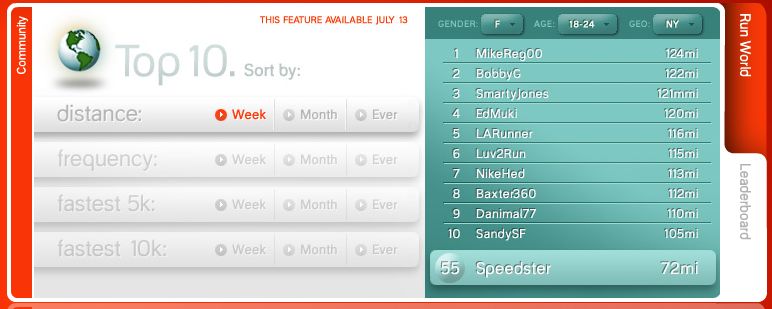
Nike has created running shoes that will wirelessly interact with an iPod mini in order to provide inspirational messages and music.
The shoe insert also appears to track distance and speed. When synced to a PC, the data is pushed to the Nike site for recording and competitive comparison.
This is perfect, I had been searching for a mechanism by which my ability to lie about how long and fast I run would be taken away from me.
Tuesday, May 23, 2006
Oh please .....
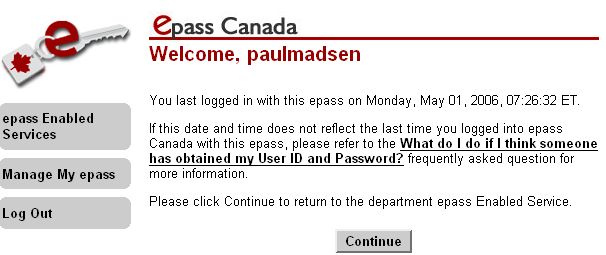
Makes me think of that Seinfeld episode where Kramer provides a movietime service
'Why not just tell me the name of the identity attack you're seeing?'
Monday, May 22, 2006
User-centric physical security?
Sunday, May 21, 2006
8th International WWW Conference
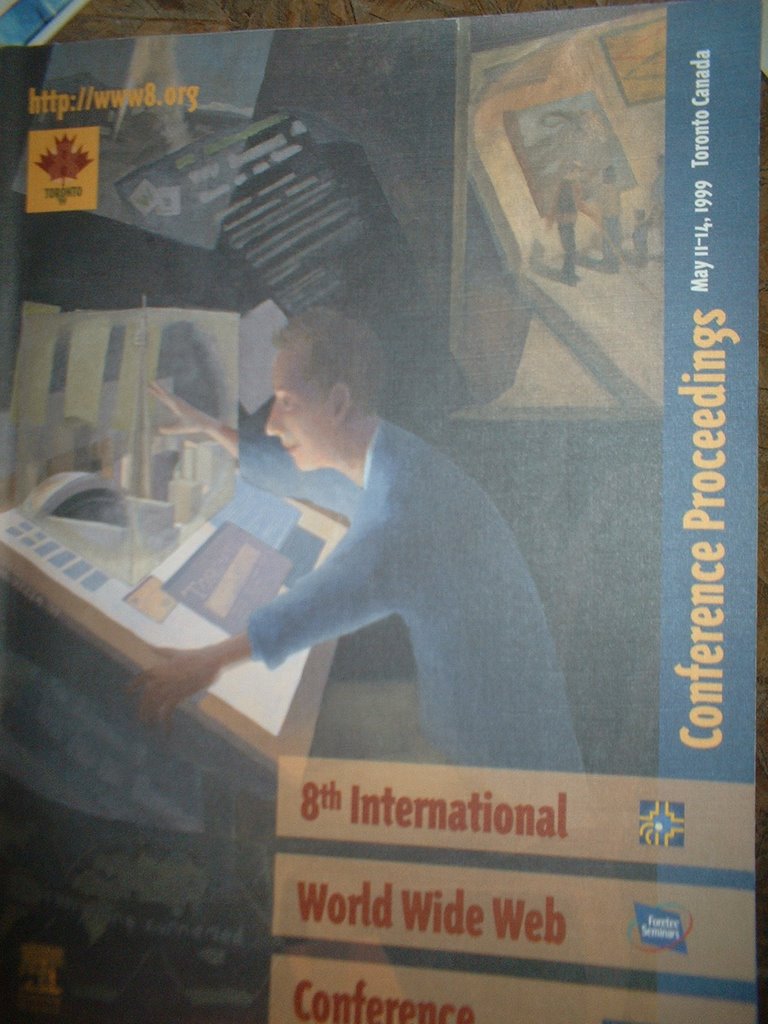 I attended the WWW8 Conference in Toronto in '99.
The list of topics from the proceeedings that warrant Program Committee Vice-Chairs is telling
- User Interface
- WWW Performance
- Searching Querying, and Indexing
- Browsers and Tools
- Electronic Commerce and Security
- Hypertext/Hpermedia
In retrospect, the panel with the topic of 'Why are all these Internet companies worth so much?' should have been a warning.
Friday, May 19, 2006
Trans-Canada Highway - a Forced Analogy

Infrastructure Canada has a history of the Trans-Canada Highway that seems to parallel the current identity world.
The Trans-Canada Highway joins all ten provinces - stretching from the Pacific to the Atlantic, it's 7,821 kilometres long. When the project was begun in 1949, the fundamental question was 'Where should the road go?'
In the past the provinces had decided the route their highways would take. Unfortunately, these provincially planned routes did not usually link up with one another at provincial borders.Not particularly interoperable
If the Trans-Canada Highway was going to stretch from one end of the country to the other, it needed to be organized to ensure that it connected at provincial boundaries. However, since highways are the responsibility of the provinces in Canada the federal government could not simply tell the provinces where to build their roads.No overarching authority
Agreeing on a point of connection between each of the provinces was further complicated by each province’s desire to connect their major cities to the Highway. The federal government tried to get the provinces to design the “shortest practicable east-west route”, but this was sometimes impractical.Different requirements
Ultimately the Trans-Canada Highway changed from a single roadway into a road network to accommodate the needs of the provinces and their major cities.A compromise solution
You can drive from one side of the country to the other - but the trip will take you over a wide range of jurisdictions, road surfaces, and terrain. The 'highway' is not a single stretch of tarmac, it's the system defined by agreements between consituents, the knitting together of multiple component highways of different capabilities (4-lane freeways vs 2-lane rural routes) and the common experience of the green markers to provide a reassuring sense of consistency.
If you prick us, do we not breed?
It seems Microsoft does not believe we Canadians have children.

Perhaps this is part of 'the plan', discourage non-Americans from population growth by turning off for us all software features that facilitate family-based identity management? Brilliant!
For myself, simply knowing that I'd be on my own in the raising of additional offspring makes me feel less inclined to do my "bit" for Canada.
Or maybe this is directly at Kim's instigation? Some long festering grudge against his homeland? Was he forced to go to the States for some two-tier medical procedure and carries his resentment to this day?
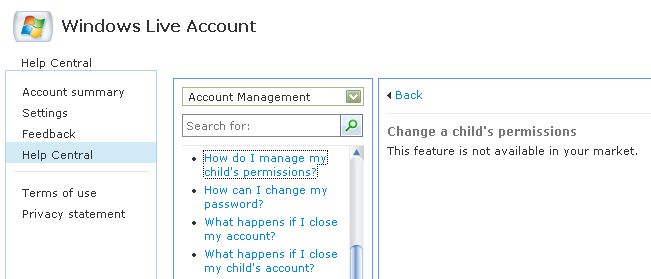
Perhaps this is part of 'the plan', discourage non-Americans from population growth by turning off for us all software features that facilitate family-based identity management? Brilliant!
For myself, simply knowing that I'd be on my own in the raising of additional offspring makes me feel less inclined to do my "bit" for Canada.
Or maybe this is directly at Kim's instigation? Some long festering grudge against his homeland? Was he forced to go to the States for some two-tier medical procedure and carries his resentment to this day?
Thursday, May 18, 2006
YAMAI - Yet Another Misconception About Interoperability
Eric Norlin posts on Verisign's just announced PIP.
Eric emphasizes PIP's support for Yadis.
YADIS allows a Relying Party, when presented with a URI corresponding to a PIP-hosted identity, to determine which URI-based identity protocols PIP supports by obtaining a descriptor document. But, at least currently, PIP only supports OpenID so any descriptor document that PIP serves up can only indicate OpenID support. If you look at the YADIS Resource Descriptor for Verisign's PIP, you see
YADIS, like WSSOMEX enables identity suite capability discovery (ISCD? sure, why not), not identity suite interoperability.
Put another way, simply knowing that you and your spouse are incompatible will not magically make you compatible (but it could save you big bucks in marriage therapy bills).
Eric emphasizes PIP's support for Yadis.
And since it works with YADIS, its not simply limited to OpenID (or LiveJournal) sites.I don't think so (at least not for this version)
YADIS allows a Relying Party, when presented with a URI corresponding to a PIP-hosted identity, to determine which URI-based identity protocols PIP supports by obtaining a descriptor document. But, at least currently, PIP only supports OpenID so any descriptor document that PIP serves up can only indicate OpenID support. If you look at the YADIS Resource Descriptor for Verisign's PIP, you see
<?xml version="1.0" encoding="UTF-8"?>Nothing but OpenId. So, while it may be nice for a LID (or other system)-based RP to retrieve this XML and discover this fact, it won't magically enable that RP to communicate with the OpenID-based PIP.
<xrds:XRDS
xmlns:xrds="xri://$xrds"
xmlns:openid="http://openid.net/xmlns/1.0"
xmlns="xri://$xrd*($v*2.0)">
<XRD>
<Service priority="10">
<Type>http://openid.net/signon/1.1</Type>
<Type>http://openid.net/sreg/1.0</Type>
<URI>http://username.pip.verisignlabs.com/server</URI>
</Service>
<Service priority="20">
<Type>http://openid.net/signon/1.0</Type>
<Type>http://openid.net/sreg/1.0</Type>
<URI>http://username.pip.verisignlabs.com/server</URI>
</Service>
</XRD>
</xrds:XRDS>
YADIS, like WSSOMEX enables identity suite capability discovery (ISCD? sure, why not), not identity suite interoperability.
Put another way, simply knowing that you and your spouse are incompatible will not magically make you compatible (but it could save you big bucks in marriage therapy bills).
TSODI - Episode #27 - Part 1
Aldo interviews Johannes Ernst, Dick Hardt, and John Kemp on the topic of user-centric identity in this week's episode (mp3).
At the start of each episode, Aldo reads out the names and introductions of people who have added themselves to the SODI Frapper Map in the past week. A noteworthy addition to the map is Seung-Hyun Kim, a South Korean IDM researcher. His introduction includes:
For Dick, user-centrism boils down to how the identity is communicated from identity provider to identity consumer - the user must be an active intermediary in the flow in order to apply their release policies (my interpretation being that back-channel SOAP messaging on the user's behalf would be ruled out as deserving the user-centric description). John takes a broader view, user control is the key aspect of user-centric and a user can still have meaningful control even when not directly involved in the identity flow.
Hopefully this distinction is explored further in Part 2.
At the start of each episode, Aldo reads out the names and introductions of people who have added themselves to the SODI Frapper Map in the past week. A noteworthy addition to the map is Seung-Hyun Kim, a South Korean IDM researcher. His introduction includes:
I am working at ETRI, the Electronics and Telecommunications Research Institute. Our team is named as the Digital ID Research Team, developing systems that follow standards such as Liberty, SAML, ID-WSF, and XACML. I have been certified through the first SAML 2.0 interoperability test from Liberty Alliance in 2005. We now supply the Ministry of Naitonal Defense with the system ... this will be used by over 230 cities in Korea, that means that 48 million Liberty-enabled identies will be created.In the interview itself (and vastly oversimplifying) I saw what seems a fundamental divide when the interviewees were asked to give their definition of user-centric identity.
For Dick, user-centrism boils down to how the identity is communicated from identity provider to identity consumer - the user must be an active intermediary in the flow in order to apply their release policies (my interpretation being that back-channel SOAP messaging on the user's behalf would be ruled out as deserving the user-centric description). John takes a broader view, user control is the key aspect of user-centric and a user can still have meaningful control even when not directly involved in the identity flow.
Hopefully this distinction is explored further in Part 2.
DRM - Disc Recordings Management
Instructions for pirating a vinyl record.
This would be easily prevented by embedding 1" perpendicular 'anti-copy pegs' into the original (which would of course stop the owner from the fair use of actually playing the record but that's been my experience of DRM anyways).
This would be easily prevented by embedding 1" perpendicular 'anti-copy pegs' into the original (which would of course stop the owner from the fair use of actually playing the record but that's been my experience of DRM anyways).
Tuesday, May 16, 2006
Fishing for dolphins
Dolphins apparently use unique whistle vocalizations to identify themselves to others. Kind of like Roger Whittaker's Durham Town.
The story has been blogged here and here. The paper that presents the research touches on a number of identity aspects to the story that I haven't seen discussed elsewhere:
The story has been blogged here and here. The paper that presents the research touches on a number of identity aspects to the story that I haven't seen discussed elsewhere:
- The whistles actually convey identity, i.e. it's not the sound of the dolphin's voice that others recognize, it's the pattern of the whistle itself.
- A consequence of the previous is that it would be possible for one dolphin to impersonate another by using that dolphin's unique signature whistle. It seems they do this.
- The identifiers are both global (e.g. a dolphin uses the same whistle to identify itself to all other dolphins) and persistent across the lifetime of the animal. Apparently, privacy is not a big concern at the moment. This will likely change as more and more get 'fished'.
I don't know art but I know what I remember ..
An interesting idea for a hardware token.
I suppose it could be phished through some PBN (paint by numbers) attack.
I definitely wouldn't want to wear it around my neck.
I suppose it could be phished through some PBN (paint by numbers) attack.
I definitely wouldn't want to wear it around my neck.
Beer 2.0?
Dave Kearns believes that 'Canadians are smart about identity'.
Canadians love it when Americans pay attention to us (but not to our softwood lumber or beef), so this prompted me to search on 'canadian identity complex'. The results led me to Kaliya's previous post on the subject of Canadian Cultural Identity.
The theory seems to be that Canadians pay attention to identity because of two forces - our proximity to the US is an external push threatening to squash us as a distinct culture/society, and the English/French divide is an internal tidal pull threatening to tear us apart. We are squeezed from North to South and torn apart from East to West.
It seems fitting that these forces are best summarized by a beer commercial (which seems strangely similar to another 'identity-focussed' presentation that has emerged from Canada).
Canadians love it when Americans pay attention to us (but not to our softwood lumber or beef), so this prompted me to search on 'canadian identity complex'. The results led me to Kaliya's previous post on the subject of Canadian Cultural Identity.
The theory seems to be that Canadians pay attention to identity because of two forces - our proximity to the US is an external push threatening to squash us as a distinct culture/society, and the English/French divide is an internal tidal pull threatening to tear us apart. We are squeezed from North to South and torn apart from East to West.
It seems fitting that these forces are best summarized by a beer commercial (which seems strangely similar to another 'identity-focussed' presentation that has emerged from Canada).
Wednesday, May 10, 2006
Dignity & Power Cords
If somebody ever invents a way in which to plug in your laptop to power extension cords at a meeting/conference without the completely dignity-robbing act of crawling under tables ....
Actually, I'm about to present at the OASIS Symposium - shouldn't there be some sort of support staff to plug it in for me?
Actually, I'm about to present at the OASIS Symposium - shouldn't there be some sort of support staff to plug it in for me?
World's first demo of Liberty People Service
My colleague Yuzo Koga posts (in Japanese) about the world's first demonstration of a Liberty People Service implementation at the RSA Japan conference
My fluent skills in Nihongo allow me to provide the following translation:
My fluent skills in Nihongo allow me to provide the following translation:
Can you please tell me where is Shinjuku Station? "RSA Conference Japan 2006" Good morning, how are you? I am well thank you. "Liberty Alliance Project" Does this train go to Akhibara? "ID-WSF People Service" I'd like a beer please.
Tuesday, May 09, 2006
Identity Selector sequence
An interesting animated sequence portraying an identity selector in action. Before releasing some identity to a Service Provider, the user is given the opportunity to view the identity that will be shared, and to edit this set. Normal stuff.
What I find interesting is how the mock-up also shows how the SP can 'make its case' to the user by describing how the services being offered may be contingent on what identity pieces are shared. So, for instance, when the user decides not to share their email address with the SP, the available levels of service (each with different permissions attached) the SP is willing to provide changes accordingly. With knowledge of the consequences of withholding particular identity bits, the user is able to make an 'informed consent' decision about its release.
But I don't know of any identity protocols that explicitly support the SP providing this sort of 'offer' information when it requests identity from an IDP. Are there?
Given that the demo portrays a Shib-based system, perhaps Sibboleth added this piece to SAML? I've never heard of such an extension. More likely is that the SP has simply communicated these rules to the IDP beforehand so that the IDP effectively advertises the policy to the user. Not a particularly dynamic model.
What I find interesting is how the mock-up also shows how the SP can 'make its case' to the user by describing how the services being offered may be contingent on what identity pieces are shared. So, for instance, when the user decides not to share their email address with the SP, the available levels of service (each with different permissions attached) the SP is willing to provide changes accordingly. With knowledge of the consequences of withholding particular identity bits, the user is able to make an 'informed consent' decision about its release.
But I don't know of any identity protocols that explicitly support the SP providing this sort of 'offer' information when it requests identity from an IDP. Are there?
Given that the demo portrays a Shib-based system, perhaps Sibboleth added this piece to SAML? I've never heard of such an extension. More likely is that the SP has simply communicated these rules to the IDP beforehand so that the IDP effectively advertises the policy to the user. Not a particularly dynamic model.
You can't get there from here
New York Times has an article on Boeing's new 787 Dreamliner.
Why is there an IDP in the mix? Shouldn't a user be able to simply take off from any dinky airport and land anywhere else - no need for a 'hub' in the middle.
Sounds great. But, maybe airports would be concerned about the aircraft safety processes of the various other airports that they would be expected to accept flights from. Would you want planes of unknown structural integrity landing on your nice new runways? Who is to say that their landing gear will work, or that they won't spray oil on your tower. As an Air Traffic Controller, would you accept some rickety Cessna coming in on a wing and a prayer (literally)? Maybe you would, but I bet you'd route them out to Runway 04/22R out on the edge of the field.
That said, if I never fly through O'Hare's Terminal 2 again, that will be just fine.
The 787 is designed to carry 220 to 300 people on routes from North America to Europe and Asia. Boeing is counting on it to replace the workhorse 767, which is being phased out, and, it hopes, a few Airbus models as well. Its advantages go beyond fuel efficiency: Boeing designed the 787 to fly long distances while keeping passengers relatively comfortable.The SAML/Liberty architecture is often equated with a hub and spoke identity model - the user gets to their SPs through their IDP, the IDP is presented as some undesired interloper (think Chicago O'Hare) sitting in the middle of the actually desired interaction (getting from the East coast to the West).
That approach grows out of another gamble by Boeing — that the future of the airline business will be in point-to-point nonstop flights with medium-size planes rather than the current hub-and-spoke model favored by Airbus, which is developing the 550-seat A380 superjumbo as its premier long-haul jetliner. Flying point to point eliminates the need for most passengers to change planes, a competitive advantage so long as the Dreamliner is as comfortable and as fast as a bigger aircraft.
Why is there an IDP in the mix? Shouldn't a user be able to simply take off from any dinky airport and land anywhere else - no need for a 'hub' in the middle.
Sounds great. But, maybe airports would be concerned about the aircraft safety processes of the various other airports that they would be expected to accept flights from. Would you want planes of unknown structural integrity landing on your nice new runways? Who is to say that their landing gear will work, or that they won't spray oil on your tower. As an Air Traffic Controller, would you accept some rickety Cessna coming in on a wing and a prayer (literally)? Maybe you would, but I bet you'd route them out to Runway 04/22R out on the edge of the field.
That said, if I never fly through O'Hare's Terminal 2 again, that will be just fine.
Monday, May 08, 2006
Lounging around
Travelling through Toronto to San Francisco, I expected to have to log-in to my DataValet account in order to access the free Wifi in the Maple Leaf Lounge at YYZ. I've long relied to Firefox's ability to store details for accounts such as this cause there is no way I'd remember otherwise.
Instead, this time, I was given the option of using either a cell phone number or my Aeroplan number as account and no password.
Next time I'll read the agreement to see what I've agreed to allow them to do with my number.
Instead, this time, I was given the option of using either a cell phone number or my Aeroplan number as account and no password.
Next time I'll read the agreement to see what I've agreed to allow them to do with my number.
Saturday, May 06, 2006
Identity Disclaimer
Given that there is a proposed new disclaimer for the internet itself, perhaps we need something comparable for identity.
Your identity is precious, share it on the Web at your own risk. Many sites will ask you for it, you almost certainly should decline. If you do decide to share, do not place any great hope that you can control the uses of your identity information once you click the 'Send' button - it's gone. Repeat after me - 'gone'. If you provide your email address, you should proactively add the site to your email filters 'spam list' because, regardless of what you told them, they will probably send you 'newsletters'. You should never give your real identity, instead make up the details of your life - it works for you in the bars, why change? If you provide your shipping address, expect that it will be sold and you will subsequently receive junk mail alerting you to 'incredible time-share opportunities' (do not buy into the Poconos - it's a bubble and your investment will be lost). When asked to provide a password, chose something easily memorable - hackers will appreciate the courtesy and possibly do less damage. And you know those people that say that the risk of giving your credit card to a restaurant waiter is greater than sharing the number online - well those people probably bought into the Poconos Bubble. The Web is no place for your identity, keep it in your wallet.
Thursday, May 04, 2006
Identity and Reputation and Opinion
Johannes likes Phil Windley's distinction between identity and reputation:
I think this is a bit of an over simplification in that it doesn't capture the collective aspect of reputation. I'd say that a single user's 'story about me' is opinion rather than reputation. It only becomes reputation when combined with the opinions of others.
So, my mod would be:
Identity is my story about me.
Reputation is your story about me.
I think this is a bit of an over simplification in that it doesn't capture the collective aspect of reputation. I'd say that a single user's 'story about me' is opinion rather than reputation. It only becomes reputation when combined with the opinions of others.
So, my mod would be:
Identity is my story about me.
Opinion is your story about me.
Reputation is the aggregation of the opinion of a number of others.
Visual Cues for Wikis
Phil Windley discusses the possibility of using visual metaphors on Wiki pages as cues to the readers.
At the Liberty Alliance meeting last week in DC, we joked about something similar for Wikipedia - a scale against which the left/right bias of particular pages could be set. Something comparable to Homeland Security.
A simple thing you could do is to “age” pages so that page color changes the older and staler a page is. Using a visual metaphor gives information without making an explicit reputation claim.
Wednesday, May 03, 2006
How did they hit on 92?
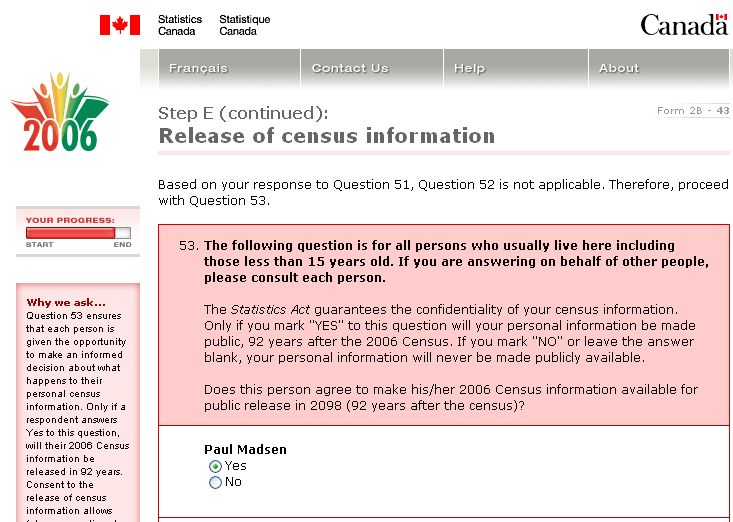
I just completed the 2006 Canadian Census online.
As befitting a country with two official languages, there were the expected many pages of questions covering what fraction of the time I spoke English/French at home, at work, in public transit, in private transit, on the toilet etc.
At the end of the survey, each member of my household was given the opportunity to opt-in for the public release of our data at some point in the future - specifically 92 years from now.
I gave my consent just so I won't have to deal with them pestering me when I'm 134.
I think we need a Canada specific Identity Rights Agreement policy & identifier.
SXIP 2.0, We Hardly Knew Ya
Eve Maler reports from IIW that:
The new news here was that SXIP is moving its DIX standardization effort into a form that is built on top of SAML — he called it a “user-centric profile of SAML”. This is great news, and I’m eager to see how this is shaping up; John Merrells is doing a session today on that.It definitely is good news. Begs the question, if DIX was to be SXIP 2.0 standardized, but is now to be a profile of SAML 2.0, where does that leave SXIP 2.0?
Unexpected Search Results
When searching on "Liberty extensions" I was not expecting this.
I resent the 'stunt' characterization - they should try writing specs balanced on each others shoulders!
I resent the 'stunt' characterization - they should try writing specs balanced on each others shoulders!
Monday, May 01, 2006
Location-based poetry
James Kobielus has written a peom entitled Geo. When I saw the title I confess I thought it would be about geolocation - maybe the privacy aspects. It isn't.
But it did get me thinking that maybe there is a business plan for geolocation-based poetry delivery. If I'm walking downtown, some futuristic haiku gets delivered to my cell, if strolling through a forest, a peacful sonnet. Or, if inactivity can be inferred, an iambic warning against sloth. Endless possibilities.
The advertisers would abuse it of course.
But it did get me thinking that maybe there is a business plan for geolocation-based poetry delivery. If I'm walking downtown, some futuristic haiku gets delivered to my cell, if strolling through a forest, a peacful sonnet. Or, if inactivity can be inferred, an iambic warning against sloth. Endless possibilities.
The advertisers would abuse it of course.
Wednesday, April 26, 2006
WS-Fishy in Denmark

Tag Lady points to a interesting decision from the Danish Government.
Makes me proud of my Danish heritage.
Friday, April 21, 2006
PKI - the four letter acronym
Entrust, after the last few years spent trying to deny their PKI heritage, seem to be now embracing it - even to the extent of hiliting it on their home page.
Thursday, April 20, 2006
Calendar Confusion & Shared Credentials
I was playing around on the new Google Calendar and searched on 'identity' in the available public calendars. I hit on a calendar owned by an identity colleague. Interspersed amongst industry events were a few that appeared out of place, e.g. 'Girls Night Out' and 'Take kids to school'.
My own personal calendar has lots of the latter type events (but distressingly few of the former) so I can definitely sympathise with the confusion by which these private events snuck into the public calendar.
It also points out an interesting issue, the private events that snuck in actually belonged (in the sense of who was going to be attending) to my colleague's wife. Google allows you to create separate categories for events (labelled as different calendars under the same Google account) and treat them differently with respect to sharing - which is what my colleague (call him Husband) did.
Also possible would have been for the lady of the house (call her Wife) to have created her own calendar under her own account, make it public and exportable, to be then imported into that of Husband. Likewise for the reverse direction - each would see their own events as well as those of their partner.
Another possibility would be for one or the other to define a 'Family Calendar' of shared events (e.g. dinner parties, vacations, etc) - this to be imported into both the personal calendars of Husband and Wife. When Husband viewed his calendar, he would see his own events as well as the shared family events - likewise for Wife. Importantly, neither would need see the details of the personal events of the other (except perhaps availibility for scheduling purposes).
This concept of shared resources (the family calendar) is important to operators and ISPs because there are situations in which an authentication, while insufficient to enable access to private resources, may be sufficient to enable access to such a shared resource. This sort of authentication is generally passive - consisting of the user opening some communication channel - and so of interest to those who provide such communication channels.
Consider Husband accessing the internet through the home PC he shares with Wife. The implicit authentication performed when he accesses the Web from the static IP associated with his ISP account can be sufficient for the ISP to identify him as one of the set of users associated with that account, and who therefore can view the shared calendar. But, because the "credential" by which Husband authenticated to the ISP (possession of that IP address) is shared with Wife - the ISP would be unable to determine which of the two was actually authenticating. But that's OK, because the access rules for the Family calendar would stipulate that anybody coming from that IP address would be allowed to view (and likely change) the Family Calendar.
If however, Husband then wished to view his own private calendar, the ISP would need to authenticate him as an individual in order to disambiguate him from Wife. At this point, he would then present a password etc unique to his account - the shared credential no longer sufficient for the task at hand.
When the resources being accessed are remote from the entity authenticating the user (e.g. if Google was hosting the various calendars but Husband and Wife were being authenticated by their ISP) then the Service Provider (Google) needs a way to stipulate to the Identity Provider (ISP) its requirements of an authentication (e.g. I need something that pinpoints the user as an individual).
Fortunately, SAML 2.0 provides a framework that allows Service and Identity Providers to discuss just such details about how the user authenticates (and much more) - its called Authentication Context. Work is currently under way in the SSTC to explore whether the existing Authentication Context mechanisms in SAML 2.0 need be extended to support this concept of Shared Credentials.
My own personal calendar has lots of the latter type events (but distressingly few of the former) so I can definitely sympathise with the confusion by which these private events snuck into the public calendar.
It also points out an interesting issue, the private events that snuck in actually belonged (in the sense of who was going to be attending) to my colleague's wife. Google allows you to create separate categories for events (labelled as different calendars under the same Google account) and treat them differently with respect to sharing - which is what my colleague (call him Husband) did.
Also possible would have been for the lady of the house (call her Wife) to have created her own calendar under her own account, make it public and exportable, to be then imported into that of Husband. Likewise for the reverse direction - each would see their own events as well as those of their partner.
Another possibility would be for one or the other to define a 'Family Calendar' of shared events (e.g. dinner parties, vacations, etc) - this to be imported into both the personal calendars of Husband and Wife. When Husband viewed his calendar, he would see his own events as well as the shared family events - likewise for Wife. Importantly, neither would need see the details of the personal events of the other (except perhaps availibility for scheduling purposes).
This concept of shared resources (the family calendar) is important to operators and ISPs because there are situations in which an authentication, while insufficient to enable access to private resources, may be sufficient to enable access to such a shared resource. This sort of authentication is generally passive - consisting of the user opening some communication channel - and so of interest to those who provide such communication channels.
Consider Husband accessing the internet through the home PC he shares with Wife. The implicit authentication performed when he accesses the Web from the static IP associated with his ISP account can be sufficient for the ISP to identify him as one of the set of users associated with that account, and who therefore can view the shared calendar. But, because the "credential" by which Husband authenticated to the ISP (possession of that IP address) is shared with Wife - the ISP would be unable to determine which of the two was actually authenticating. But that's OK, because the access rules for the Family calendar would stipulate that anybody coming from that IP address would be allowed to view (and likely change) the Family Calendar.
If however, Husband then wished to view his own private calendar, the ISP would need to authenticate him as an individual in order to disambiguate him from Wife. At this point, he would then present a password etc unique to his account - the shared credential no longer sufficient for the task at hand.
When the resources being accessed are remote from the entity authenticating the user (e.g. if Google was hosting the various calendars but Husband and Wife were being authenticated by their ISP) then the Service Provider (Google) needs a way to stipulate to the Identity Provider (ISP) its requirements of an authentication (e.g. I need something that pinpoints the user as an individual).
Fortunately, SAML 2.0 provides a framework that allows Service and Identity Providers to discuss just such details about how the user authenticates (and much more) - its called Authentication Context. Work is currently under way in the SSTC to explore whether the existing Authentication Context mechanisms in SAML 2.0 need be extended to support this concept of Shared Credentials.
Ingenious eh?
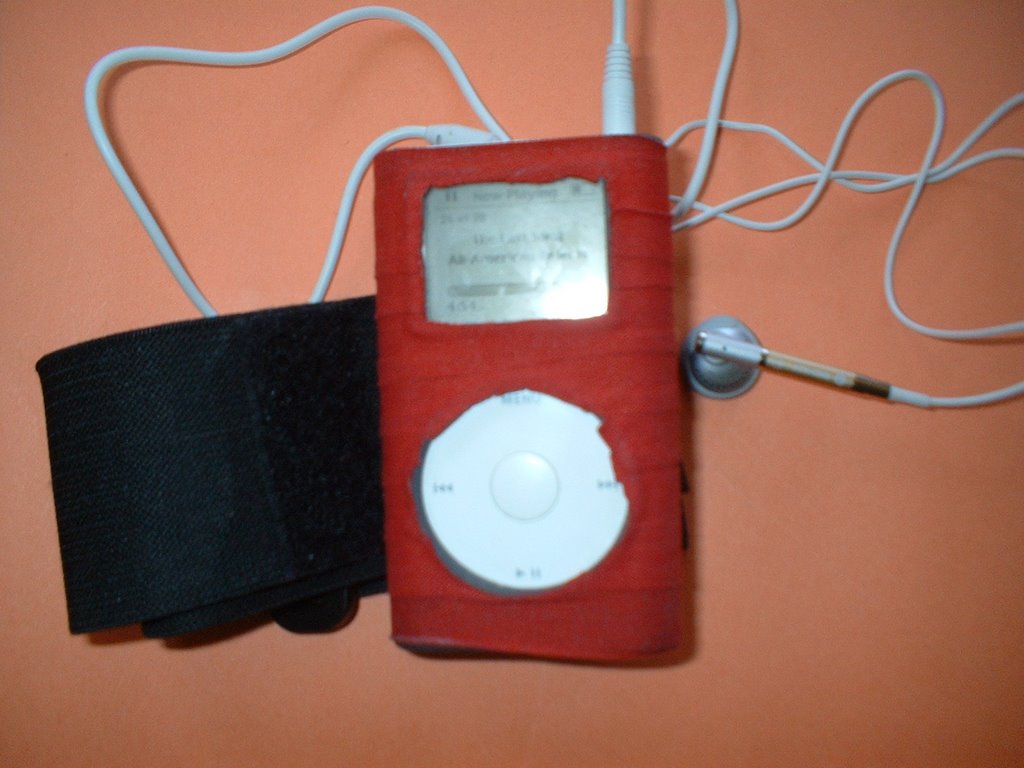
The rubber of my iPod Mini holder split at the back where the armband went through.
To keep it together I wrapped it round with good ol' Canadian Tire hockey tape (red no less).
Duct tape just seemed so 90s.
Wednesday, April 19, 2006
You show me yours ....
I can think of a number of situations where I might be willng to release some slice of my identity only if the individual making the request (or on whose behalf the request was being made) was willing to share that same information (or perhaps even some other aspect of their identity) with me.
For example
To duplicate this in the digital world would require a number of pieces (not necessarily all):
For example
- geolocation - if you want to know where I am, before I decide to approve the request I want to know where you currently are. Maybe I won't share mine if you are within a certain minimum distance.
- home address - similar to above but perhaps I'll only release my address if you live in the same city
- marital status - 'nuff said
To duplicate this in the digital world would require a number of pieces (not necessarily all):
- the ability to express this preference as an access control policy.
- the ability for this preference to be advertised to potential requestors, or the ability for non-compliant requests to be failed with appropriate fault information.
- the ability for a request for some piece of identity to include any of
- the same piece of identity for the requestor.
- the location of the same piece of data for the requestor.
- how to discover the same piece of data for the requestor.
Identity Middlespace?
Ross Mayfield writes of the middlespace - a hypothesized region where bottom-up phenomena meet top-down in a synergistic collision.
One quote caught my eye:
Notwithstanding that this distinction is, in some aspects, either completely wrong (Liberty can support user-hosted identity for instance) or a gross oversimplification (top-down identity provides more than governance and incentives, and bottom-up provides more than merely enthusiasm); the identity metasystem at least promises to be where top-down and bottom-up identity meet. The "identity middlespace".
One challenge (with associated risk) will be in dealing with the impedance mismatch presented by the different security & privacy characteristics of the various systems. Different use cases (blog commenting vs 401K access) result in (appropriately) different sets of requirements, which subsequently manifest themselves in varying security & privacy characteristics. Step-down might be easy, step-up though?
Risk and opportunity - rife indeed.
One quote caught my eye:
...when rules are kept simple and incentives are provided from the Top-down, the energies of the Bottom can be realized for mutual gain. However, negotiating the sharing of control is both ripe with risk and opportunity.In today's identity, SAML, Liberty, and Infocard are typically presented as top-down initiatives; LID, OpenID, YADIS as bottom-up.
Notwithstanding that this distinction is, in some aspects, either completely wrong (Liberty can support user-hosted identity for instance) or a gross oversimplification (top-down identity provides more than governance and incentives, and bottom-up provides more than merely enthusiasm); the identity metasystem at least promises to be where top-down and bottom-up identity meet. The "identity middlespace".
One challenge (with associated risk) will be in dealing with the impedance mismatch presented by the different security & privacy characteristics of the various systems. Different use cases (blog commenting vs 401K access) result in (appropriately) different sets of requirements, which subsequently manifest themselves in varying security & privacy characteristics. Step-down might be easy, step-up though?
Risk and opportunity - rife indeed.
Tuesday, April 18, 2006
Alice doesn't live here anymore
In developing the Liberty People Service, we often relied on a particular use case (a principal named Bob trying to determine the coordinates of his friend Alice) to help us clarify requirements.
Having one user ask (or more likely a provider asking on behalf of that user) for a resource 'owned' by another, and maintaining the privacy of each through pairwise pseudonyms, presented us with a variety of challenges, both conceptual and technical.
Over time, Bob and Alice (and sometimes the mysterious 'Tony', was he Alice's friend or what? He just kind of showed up) almost became honourary members of the Technology Expert Group.
But, overtime, familiarity bred contempt.
Bob, I am sick and tired of your incessant whining and repeated 'Where are you Alice?'. Take the hint buddy. If she liked you don't you think she'd actually be close enough that you wouldn't have to ask? And Alice, how about being honest for once in your life and just tell Bob how you feel? Women like you make me sick with how you lead guys on!
Jigsaw 's Missing Pieces
Jigsaw presents itself as
So, if you hand me your business card, I can effectively sell that information to Jigsaw. My gain, your (through the potential for cold calls from salespeople) loss.
You almost certainly weren't thinking of my abusing the privilege in this way when you gave me your business card. But, beyond scribbling across the front a non-enforceable 'Not for Resale', there is not much you can do to stop me.
If however, you had initially provided me your contact info digitally, then you could at least be given mechanisms/syntax in order to express any restrictions you might wish to impose on me. Such restrictions could include limiting sharing, constraints on contact (e.g. don't use IM before noon), or limits on how long the info could be stored).
Such preferences would still almost certainly remain unenforceable but I could no longer claim innocence or ignorance. Importantly, neither could Jigsaw if the preferences stayed with the contact info if and when submitted there.
Identity Rights Agreements would make this possible.
an online business contact marketplace where marketers, recruiters, and sales people can buy, sell and trade business contact informationMembers buy their way in, either through a monthly subscription fee or by providing a certain number of their contacts to the system. Yes, the currency is the contact info of your friends and colleagues.
So, if you hand me your business card, I can effectively sell that information to Jigsaw. My gain, your (through the potential for cold calls from salespeople) loss.
You almost certainly weren't thinking of my abusing the privilege in this way when you gave me your business card. But, beyond scribbling across the front a non-enforceable 'Not for Resale', there is not much you can do to stop me.
If however, you had initially provided me your contact info digitally, then you could at least be given mechanisms/syntax in order to express any restrictions you might wish to impose on me. Such restrictions could include limiting sharing, constraints on contact (e.g. don't use IM before noon), or limits on how long the info could be stored).
Such preferences would still almost certainly remain unenforceable but I could no longer claim innocence or ignorance. Importantly, neither could Jigsaw if the preferences stayed with the contact info if and when submitted there.
Identity Rights Agreements would make this possible.
Liberty adoption
Liberty's latest newsletter indicates that adoption is soaring.
We're like a MySpace with far fewer predators.
We're like a MySpace with far fewer predators.
In a previous life ...
I played alot of Ultimate in the Ottawa-Carleton Ultimate Association league (which used to be the largest in the world, perhaps still is), the monthly newsletter and web site for which I used to write a piece parodying Jack Handey's Deep Thoughts.
I've started a new blog at Cheap Thoughts to begin a list of the collection.
I've started a new blog at Cheap Thoughts to begin a list of the collection.
I feel your pain
Like myself, John Kemp is close to 40 (but the other side of it) and feeling the "slings and arrows of outrageous fortune" associated with this age and corresponding life milestones.
But he still enjoys getting out for a run, as I do. Maybe a slower pace, probably a stop mid-way through, almost certainly not as long, but at least I'm not wearing velcro walking shoes.
But he still enjoys getting out for a run, as I do. Maybe a slower pace, probably a stop mid-way through, almost certainly not as long, but at least I'm not wearing velcro walking shoes.
Subscribe to:
Posts (Atom)